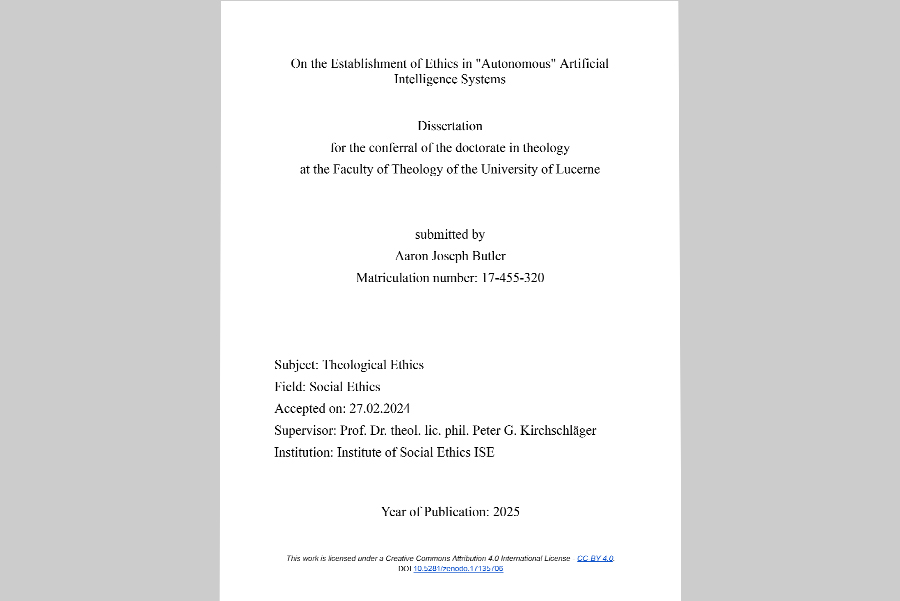
On the Establishment of Ethics in "Autonomous" Artificial Intelligence Systems
Aaron Joseph Butler's dissertation in ethics is now available open access on Lory. His research asks the question whether ethics in autonomous artificial intelligence systems can come from within.
From the introductory Chapter:
The aim of this research project is to investigate whether ethics can be established “internally” within “autonomous” artificial intelligence systems in such a way so as to show that they are performing some type of ethical analysis in virtue of an internal set of instructions and architecture and by means of ethical design norms in addition to whatever engineering design norm requirements that need to be satisfied as well as to provide an explicit characterization of an ethically prospective approach to ethics of artificial intelligence, instead of an ethically retrospective “troubleshooting” approach. Moreover, it is hoped that some of the benefits that would result from this twofold aim are that the ethically prospective approach would also provide a way to optimize value-based engineering efforts, to assist in localizing or narrowing down the moral responsibility assessment to a clearly defined set of stakeholders, thereby providing an answer to the intuitive interrogative which began the mainstay inquiry of this project, all of which, or so it is hoped, and can strengthen policy recommendations regarding use of such systems in various social roles.
The upshot here being: in the project of this book, the author attempts to provide a systematic way to select from the class of all possible values a specific subset of values to be embedded and implemented, in the relevant sense, within “autonomous” artificial intelligence systems. It is hoped that this specific subset of values constitutes the value basis which simultaneously can be embedded and implemented, serving as a way to shore up the engineering endeavors and the technological development lifecycle along even more ethically robust grounds than they are at present. In expressing this hope, the author is neither denying that previous efforts and endeavors ethically to regulate the relevant technology have merit nor is the author claiming or assuming that efforts in this regard are valid or effective only if they are “internal” in the relevant sense. Rather, the author has great respect and gratitude for previous efforts and endeavors ethically to regulate “autonomous” artificial intelligence systems as well as other relevant technology. Nevertheless, just as in child-rearing, a parent relies on both external and internal measures ethically to regulate one’s child’s moral behavior, so too the author attempts to develop rigorous and systematic internal measures ethically to regulate “autonomous” artificial intelligence systems. These measures, as is so in child-rearing, are not meant to replace external measures, but to complement them. Furthermore, as is also true in child-rearing, when inculcating values into one’s children, not just any moral values will do, no less is true for the relevant technical systems. Naturally, not just any internal measures will do, only a specific subset of well reasoned moral values will qualify.
Aaron Joseph Butler wrote his dissertation at the Insitute for Social Ethics at the Faculty of Theology under Prof. Dr. Peter G. Kirchschläger.
Aaron Joseph Butler
On the Establishment of Ethics in "Autonomous" Artificial Intelligence Systems
Published Open Access in Lory, 2025
Read about the Research Project in German: Jahresbericht 2022, S. 21


