University and academic culture
The University of Lucerne understands itself as a shared community built around research, teaching, learning and work. Respectful interaction, personal relationships, open dialogue, transparent communication, and fair conditions for study and employment are all core values enshrined in the University's mission statement. Every member of the university community – students, researchers, lecturers and staff – plays an active role in shaping the University and shares responsibility for nurturing a culture of collaboration.
An inclusive university and academic culture is one that recognises the diversity of educational backgrounds, life experiences and perspectives its members bring. The goal is a study and working environment in which everyone can develop their individual abilities and potential to the full. This calls for fair working conditions and procedures, unbiased performance assessments, and a broad range of career opportunities.
As part of the PgB project Inclusive Leadership Culture (2025–2026), the Office of Equal Opportunity is developing training resources to help University of Lucerne managers engage constructively with diversity. The aim is to equip managers with the skills to recognise, value and actively support diversity, and to foster an inclusive working environment. The project thereby contributes to building an inclusive organisational culture and to removing barriers for staff and students alike.
The project is being implemented by Matthias Luterbach, matthias.luterbach@unilu.ch, and Luzia Knobel, luzia.knobel@unilu.ch.
Every semester, lecturers at the University of Lucerne offer a range of courses on gender and diversity. In the course catalogue, these courses are tagged with ‘Gender/Diversity’. In the advanced search, results can be filtered using this keyword.
List of courses under the keyword ‘Gender/Diversity’ in Spring Semester 26
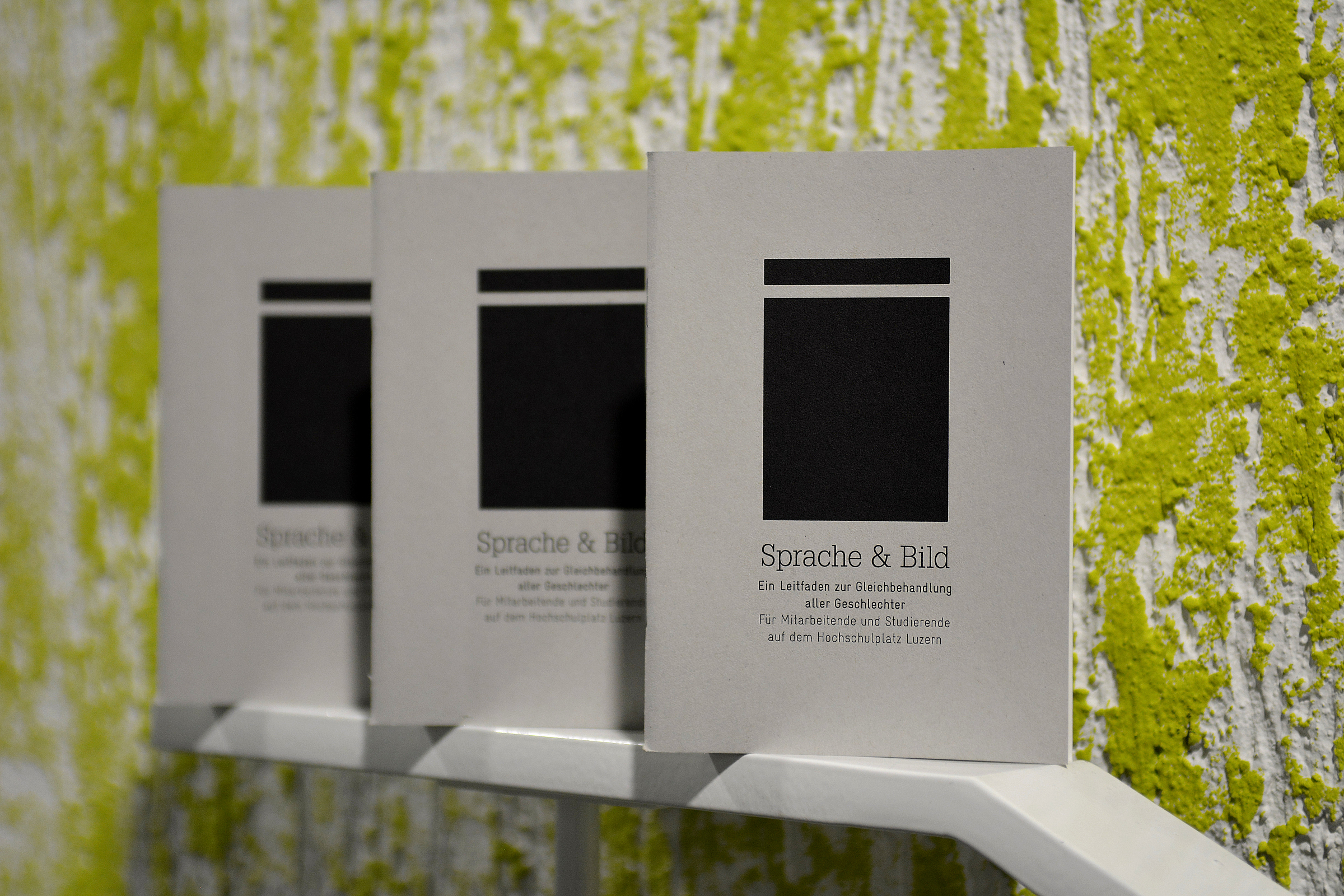
Language & Images – A Guide to Gender Equality for Staff and Students at the University of Lucerne (GERMAN)
What is the name of your favourite actor? Your favourite sports personality or favourite author?
Did men come to mind first? If so, you are in good company: studies show that when we encounter masculine forms, we tend not to picture women or people with a non-binary gender identity. For communication to be truly equal and fair, language must include all the people it is meant to address. Words and images both reflect reality and shape the way we think. Gender-inclusive language gives expression to the diversity of people; fair communication invites everyone to identify with a text and ensures greater clarity. Through thoughtful and respectful use of language and images, stereotypical role models in our minds and on the page can gradually be dismantled.
The German-language guidelines are published jointly by the three Lucerne higher education institutions: the University of Lucerne, Lucerne University of Applied Sciences and Arts, and the Lucerne University of Teacher Education. Printed copies are available from the Office for Equal Opportunities (Room 3.A24).
The English-language guidelines are published by IDEAS, the association of equality officers from the ten Swiss universities and the two Swiss Federal Institutes of Technology.
Take ten minutes to read, reflect, revise - and put it into practice!
The guide is available as a PDF download, or as a printed brochure from the Office of Equal Opportunity, Room 3.A24.


