The rhetoric of health misinformation
What do Aristotle, Plato and Cicero have to tell us about vaccine misinformation on social media? Quite a lot, as it turns out. The rhetorical tricks fuelling today's health misinformation were already well known to philosophers writing thousands of years ago – and understanding them may be our best weapon against it.
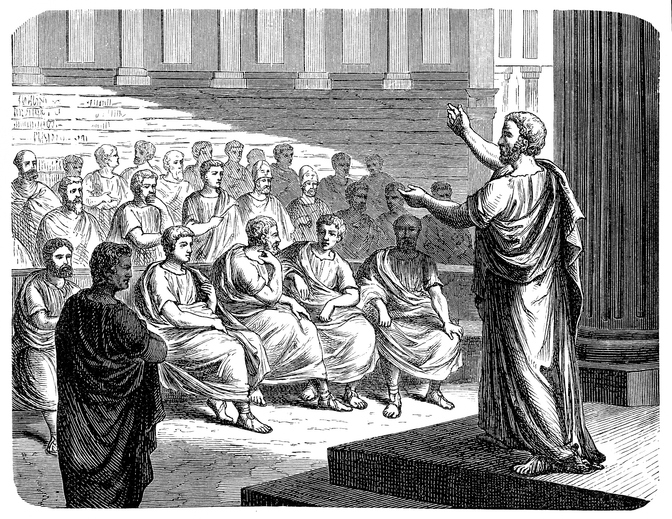
Whenever a community has to make decisions without complete information, some degree of persuasion is inevitable. Public health messaging is a perfect example: the science is rarely black and white, advice changes as new data emerges, and a particular health measure may not work equally well for everyone.
But persuasion can mislead as easily as it can inform. A message that is easy to understand but factually wrong can do real damage. Scientifically accurate health information delivered poorly will equally fail the people it was meant to reach. For Professor Sara Rubinelli, whose background bridges classics, rhetoric and argumentation theory, the tools of classical rhetoric offer a framework for pinpointing where a message breaks down, whether in its rigor, its clarity, or both.
Classical rhetoric as a diagnostic tool
In an article published in American Behavioral Scientist, Rubinelli and co-author Scott Ratzan of the City University of New York School of Public Health argue that the crisis of health misinformation is not a new phenomenon created by social media, but an ancient problem running at modern speed. Drawing on thinkers from Aristotle and Plato to Cicero and Quintilian, the authors show that the rhetorical tricks used to spread false health information today – e.g., fabricating credibility, exploiting fear, and distorting logic – were already identified and catalogued by classical philosophers millennia ago.
Drawing on classical rhetoric and modern theories of communication, the authors propose a four-part framework for evaluating health information: whether it is grounded in solid evidence; whether it balances credible sources, emotional appeal, and sound reasoning appropriately; whether it serves the common good rather than narrow interests; and whether it is genuinely accessible and understandable to all audiences. Crucially, the authors argue that being scientifically accurate is necessary but not sufficient. Information that is correct but incomprehensible, or that fails to acknowledge uncertainty, falls short of the standard that public health requires.
A call to action from leading health editors
Ancient philosophy frames the problem whose real-world implications a joint editorial in the Journal of Health Communication seeks to address. In it, editors from ten leading health and science journals worldwide – including Rubinelli as a Senior Editor – sound a collective alarm about the deteriorating integrity of health information globally. The editorial points to growing political interference in public health institutions, the rise of AI-generated misinformation, and the fragmentation of the global information ecosystem as urgent threats. Beyond undermining scientific integrity, the abandonment of shared standards of truth jeopardises social cohesion, which, the authors assert, is in part based on a shared sense of what is true and where truth comes from. That is why the dissemination of quality health information – defined as scientifically sound, accessible, clear, and actionable – is not just good scientific practice but a matter of civic duty.
The authors call for a coordinated international response: stronger regulatory frameworks, responsible governance of digital platforms and AI systems, and greater investment in digital and health literacy. Besides warning about AI’s destructive potential, the authors also see the technology as a potential asset: when properly governed, it can help detect fabricated data, flag misleading claims, and extend the reach of reliable evidence. Ultimately, the authors conclude, it is upon both individuals and institutions “to uphold the fragile bond between evidence and meaning, knowledge and responsibility, science and the common good.”
Together, the two publications make a compelling case that combating health misinformation demands more than fact-checking. It requires understanding how persuasion works, who wields it, and whose interest it serves: ancient questions that society must never stop asking.
Sara Rubinelli and Scott Ratzan
"The Ghosts of the Agora: Classical Rhetoric as a Framework for Understanding Misinformation, Populism, and Polarization in Health Communication"
American Behavioral Scientist, 2026
Scott C. Ratzan, et al.
“Safeguarding Quality in Health and Medical Science Information Today”
Journal of Health Communication, 2026


