
The Swiss healthcare system under the microscope
High-quality care, high costs and structural challenges: a new report led by researchers from the University of Lucerne highlights both the strengths of the Swiss health system and the challenges it faces.
 Enlarge image
Where does the Swiss health system stand today? This question is explored in the report Switzerland: Health System Review, published this week. The report examines developments in the Swiss health system, its organisation and financing, the way health services are provided to the population, and the challenges that must be addressed in the years ahead. It is the first updated edition since 2015.
The review forms part of the Health Systems in Transition (HiT) series and was produced under the leadership of researchers from the University of Lucerne in collaboration with the European Observatory on Health Systems and Policies, the Swiss School of Public Health (SSPH+) and the former Swiss Learning Health System (SLHS), with support from the Federal Office of Public Health. It provides an evidence-based foundation for health policy decisions and the further development of the Swiss health system.
High-quality care, high costs
As the report highlights, the Swiss health system continues to achieve very good health outcomes by international standards. With a life expectancy of more than 84 years, Switzerland ranks among the European leaders, while rates of preventable and treatable mortality remain low. The population benefits from broad access to care, extensive provider choice and short waiting times.
This strong performance comes at a price. Switzerland is among the countries with the highest health expenditure in the world. In 2023, health expenditure reached 11.7 percent of gross domestic product. Per capita spending was surpassed only by the United States. The financial burden on households remains considerable. In addition to mandatory health insurance premiums, which are not income-related, people contribute through deductibles, co-insurance and other out-of-pocket (OOP) payments.
Structural barriers slow further development
The report also identifies a number of structural challenges. Switzerland's federalist system allows health policies to be adapted to regional needs and supports innovation at cantonal level. At the same time, however, it fragments responsibilities and contributes to regional variation and inequalities.
As a result, major structural reforms often require lengthy negotiation processes and tend to be implemented incrementally. This is particularly evident in the area of digital transformation. Switzerland's health information system remains fragmented, limiting interoperability, data exchange across care settings and the systematic assessment of health system performance.
The country's hospital infrastructure has also changed substantially. Between 2000 and 2024, the number of hospitals fell from 372 to 270, while acute hospital bed density declined by around one third. At the same time, ambulatory services expanded. Nevertheless, hospital infrastructure remains unevenly distributed across the country. Differences in capacity and service availability reflect cantonal planning, population structure, urbanisation and the decentralised organisation of the health system.
Health workforce shortages
Another major challenge concerns the health workforce. Although the number of health professionals has increased significantly over the past decade, shortages remain a major concern, particularly in primary care, child and adolescent psychiatry, paediatrics, nursing and rural areas. Switzerland also relies heavily on foreign-trained health professionals. More than 40 percent of practising physicians obtained their medical degree abroad, while nursing and midwifery also depend heavily on foreign-trained staff. Demographic change and population ageing are likely to increase pressure on the system in the years ahead.
Reforms seek to strengthen coordination
Over the past decade, Switzerland has implemented a wide range of reforms in the areas of financing, cost containment, service delivery, workforce development and digital transformation. Most have been introduced incrementally and focused on individual sectors.
More recent reforms, however, are increasingly designed to strengthen coordination across care settings and improve efficiency. As the authors note, their success will ultimately depend on effective implementation.
According to the report, the central challenge for the coming years will be to preserve the strengths of the Swiss health system, namely high-quality care, broad access, patient choice and political legitimacy, while addressing rising costs, workforce shortages, digital fragmentation and uneven coordination across sectors and cantons.
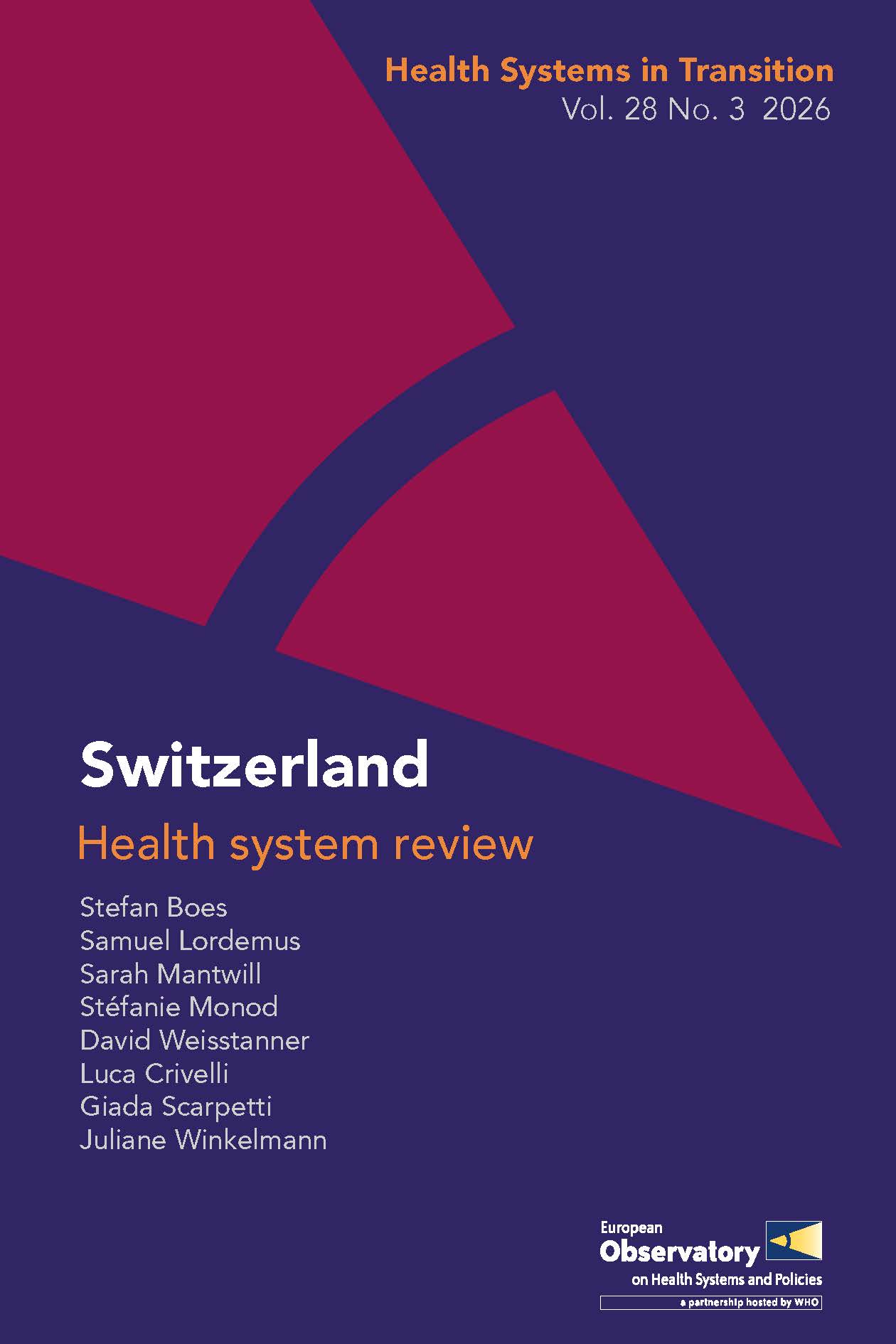
Stefan Boes, Samuel Lordemus, Sarah Mantwill et al.
Switzerland: Health System Review
European Observatory on Health Systems and Policies, WHO Regional Office for Europe; Copenhagen, 2026.
About "Health Systems in Transition"
The report forms part of the Health Systems in Transition (HiT) series published by the European Observatory on Health Systems and Policies. These regularly updated country reports provide in-depth analyses of national health systems, including their organisation, financing, performance and reform developments. Covering countries in the WHO European Region and selected OECD countries, the HiT series is designed to support policymakers, researchers and analysts in the further development of health systems.
The latest edition of the Swiss report was co-edited by Professor Stefan Boes, Dr Samuel Lordemus, Dr Sarah Mantwill und Professor David Weisstanner (all University of Lucerne), Professor Stéfanie Monod (now at the Federal Office of Public Health; at the time of her contribution at the University of Lausanne/Unisanté) and Professor Luca Crivelli (University of Applied Sciences and Arts of Southern Switzerland, SUPSI). The volume was edited by Giada Scarpetti and Dr Juliane Winkelmann of the European Observatory.
To ensure comparability across countries, all HiT reports follow a standard template developed and regularly updated by the European Observatory. They draw on national statistics, health policy documents, scientific publications and data from international organisations, including the WHO, the OECD and the World Bank. The Swiss report is based primarily on data available up to July 2026.
Switzerland’s participation as a partner in the European Observatory will end on 31 December 2026 following the discontinuation of the Federal Department of Home Affairs’ voluntary contributions to international organisations as part of the 27th budget relief package.


