
Philosophy, Politics and Economics

The Bachelor’s degree programme in Philosophy, Politics and Economics (PPE) offers a programme that is unique in Switzerland. As future decision-makers and problem-solvers, students receive a solid education in all three disciplines: philosophy, political science, and economics. Specialised seminars foster interdisciplinary thinking and working skills. In this way, students acquire the tools needed to address the challenges arising from the complexity of contemporary society.
Topics and Objectives
In recent years, political, economic, and social interconnections at both regional and global levels have increased rapidly. This growing complexity poses new and significant challenges for academia. To conduct forward-looking research and provide high-quality education, analytical, descriptive, and normative methods and insights from philosophy, political science, and economics must be brought together. The aim is to train future decision-makers and problem-solvers in all three disciplines from the very beginning of their studies, while fostering interdisciplinary thinking and working skills.
Thanks to the programme’s distinctive modular structure, which is unique in Switzerland, students in this bachelor’s degree programme acquire:
- solid subject-specific knowledge in the three disciplines of philosophy, political science, and economics, with the opportunity to specialise in one field
- the ability to think and work interdisciplinarily
- the ability to analyse, assess, and solve complex issues and problems from multiple perspectives
Study Planning and Course Progression
The Bachelor’s degree programme is structured into an assessment phase followed by a main phase. The assessment phase provides an introduction to the programme’s methodological and subject-specific foundations. Upon completion of the assessment phase, an academic guidance meeting is held to discuss the student’s suitability for the programme and to support further study planning.
An overview of the programme structure is provided by the study plans (currently available in German only).
- Studienablaufplan Vollzeit Schwerpunkt Philosophie
- Studienablaufplan Vollzeit Schwerpunkt Politikwissenschaft
- Studienablaufplan Vollzeit Schwerpunkt Ökonomie
- Studienablaufplan Teilzeit Schwerpunkt Philosophie
- Studienablaufplan Teilzeit Schwerpunkt Politikwissenschaft
- Studienablaufplan Teilzeit Schwerpunkt Ökonomie
All current courses (asseessment phase and main phase) can be found in the Vorlesungsverzeichnis and on the UniPortal.
The courses recommended for students in the assessment phase in the Spring Semester 2026 are listed in the Stundenplanübersicht.
If you have any questions concerning study planning, please feel free to contact the programme manager and academic adviser, Dr Lynn Alena Roth.
Scope and Duration
The Bachelor’s degree programme in Philosophy, Politics and Economics comprises 180 credits (Cr) in accordance with the European Credit Transfer and Accumulation System (ECTS). One credit corresponds to an average student workload of 25 to 30 hours. The standard period of study is six semesters (three years). Part-time study is possible. The programme may be commenced in either the Spring Semester or the Autumn Semester.
Das Bachelorstudium Philosophy, Politics and Economics umfasst 180 Credits (Cr) gemäss European Credit Transfer and Accumulation System (ECTS). Ein Credit entspricht einer durchschnittlichen Arbeitsleistung von 25 bis 30 Stunden. Die Regelstudienzeit beträgt 6 Semester (3 Jahre).
Philosophy, Politics and Economics as an Integrated Degree Programme
Philosophy, Politics and Economics is designed as an integrated, interdisciplinary degree programme. It provides students with academic training in all three disciplines: philosophy, political science, and economics. The programme consists of four modules.
The first module, Foundations and Methods, develops the methodological skills required for academic study in the three participating disciplines. The PPE foundation seminar highlights the connections between the disciplines and introduces students to interdisciplinary work.
The remaining three modules are each dedicated to one of the disciplines: philosophy, politics, and economics. All three subjects are studied with equal emphasis at the outset. Students then select one subject as their major, in which the Bachelor’s thesis is written.
An overview of the programme structure in accordance with the Study Regulations 2016 is provided in the following diagram.
Study Structure
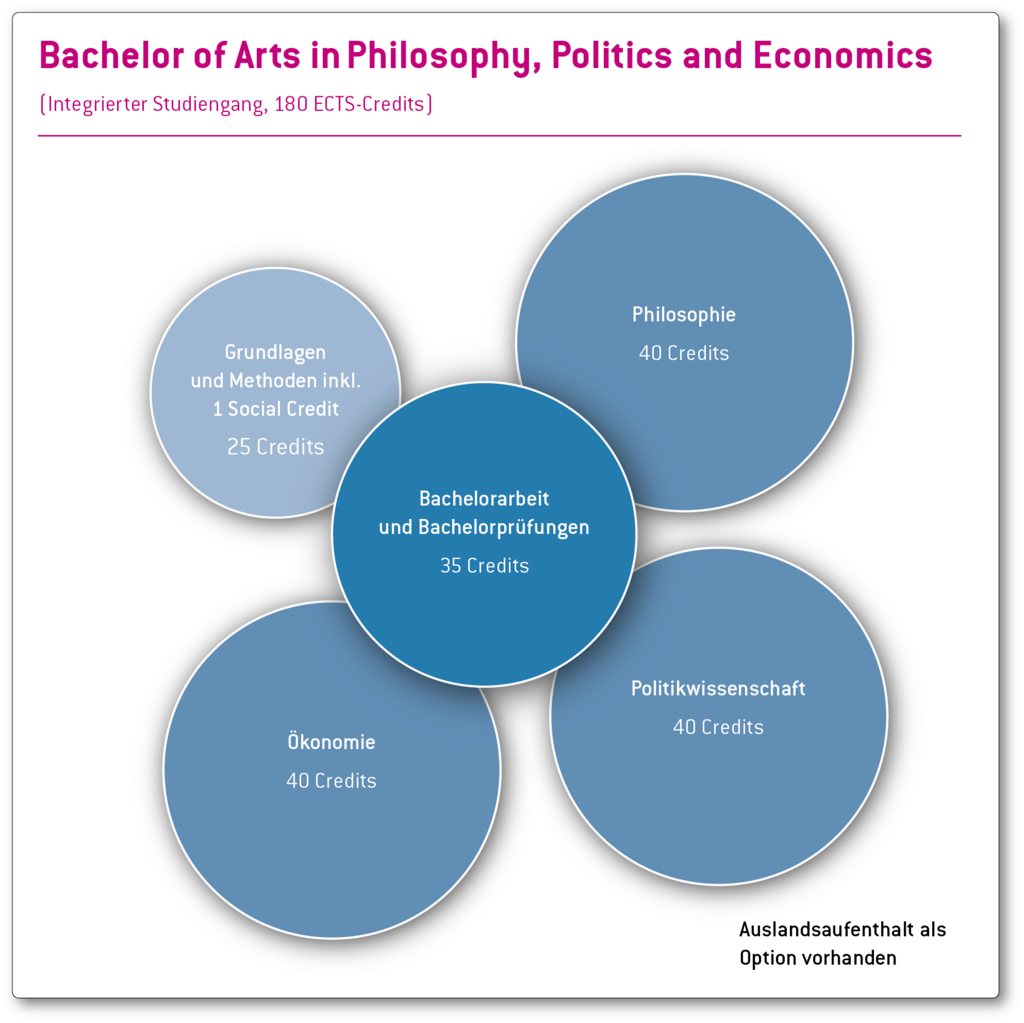
Major
Students choose one of the three subjects philosophy, politics, or economics as their major. The Bachelor’s thesis is written in the chosen major. The oral examination is also taken in the chosen major. Information on the three subjects is available on the respective programme information pages:
Degree Award
Graduates are awarded the degree of Bachelor of Arts in Philosophy, Politics and Economics, with the chosen major specified.
Langauge of Study
The courses offered in the Bachelor’s degree programme in PPE are taught primarily in German; however, courses taught in English are also available. A prerequisite for admission is proof of sufficient proficiency in German. For further information on the language requirements for admission, please consult the relevant admissions regulations: Application and Admissions page.
As part of the degree programme, students have the opportunity to complete a study period at another university in Switzerland or abroad. Important information on exchange programmes and application deadlines can be found under Mobility programmes.
Mobility Advice
Students who are interested in, or wish to apply for, a study period at another university are asked to contact the mobility adviser for their degree programme. The contact person for Philosophy, Politics and Economics is:
Dr. Lynn Roth, Programme Manager and Academic Adviser
Universität Luzern
Frohburgstrasse 3 / Raum 3.A53
Postfach
6002 Luzern
info-ppe@unilu.ch
Consultations by appointment
The PPE degree programme opens up a wide range of career opportunities in the private sector, including advisory and managerial positions in companies, as well as roles in consultancy, advertising, journalism and publishing, politics and public administration, non-governmental organisations, and international institutions.
Skills
The PPE degree programme not only provides solid subject-specific knowledge but also develops key transferable skills that are applicable across a wide range of professional contexts:
- Interdisciplinary Thinking
The ability to recognise complex interrelationships, integrate different perspectives, and develop interdisciplinary solutions. - Analytical Skills
The capacity to critically assess data and arguments, conduct systematic analyses, and make well-founded decisions. - Sense of Responsibility and Commitment to Shaping Society
An understanding of political, economic, and social structures, enabling sustainable decision-making and ethical responsibility. - Communication and Mediation Skills
The ability to present complex issues clearly, communicate effectively with different audiences, and collaborate across disciplines. - Social and Intercultural Competence
The ability to work effectively in teams, negotiate confidently, and communicate successfully in culturally diverse contexts.
Career Prospects
Studying PPE at the University of Lucerne fosters not only academic expertise but also strategic thinking, ethical judgement, and interdisciplinary analytical skills, qualifications that are highly valued in today’s labour market.
Ein Studium in PPE an der Universität Luzern vermittelt nicht nur fachliche Kenntnisse, sondern fördert auch strategisches Denken, ethisches Urteilsvermögen und interdisziplinäre Analysefähigkeiten – Qualifikationen, die in der heutigen Arbeitswelt stark gefragt sind.
Graduates of PPE work in a wide variety of fields, including:
- Politics and Public Administration
For example in ministries, cantonal authorities, international organisations, or consultancy roles. - Management Consulting and Business
For example in strategic consulting, market analysis, sustainability management, or innovation development. - Media and Communication
For example in editorial offices, press and communications departments, think tanks, or communications agencies. - Non-Governmental Organisations and International Institutions
For example in project coordination, development cooperation, research support, or specialist roles. - Education and Research
For example as research assistants, lecturers, project managers in the education sector, or through an academic career path.
Further Resources and Job Portals
Additional career resources include:
- JobbrsePolitikwissenschaftlerInnen_2020_ger.pdf -->(comprehensive overview including opportunities for graduates in philosophy and economics)
- Alle Studenten- und Absolventenjobs der Schweiz! - semestra.ch
- Medienjobs - Stellenmarkt für Kommunikation, Marketing & Medien
- Stellenbörse | Studienangebot Kulturmanagement | Universität Basel
Further Study
Pursuing a Master’s degree opens up additional career opportunities, depending on the chosen field of study.
With a Bachelor of Arts in Philosophy, Politics and Economics, graduates may apply for the following Master’s degree programmes at the University of Lucerne:
- PPE-Masterstudiengang
- Subject-specific Master’s degree programmes in Philosophie or Politikwissenschaft (for students with a major in one of these subjects), with the option of subsequent doctoral studies
- For students with a major in Economics:
- the integrated degree programme in Politische Ökonomie (until Spring Semester 2019), or the Master’s degree programme in Wirtschaftswissenschaften (from Autumn Semester 2019), subject to additional requirements
- Subject-specific Master’s degree programmes with a minor at Master’s level, provided that at least 60 credits have been earned in the relevant subject and no Bachelor’s thesis in that subject is required (additional requirements apply for Wirtschaftswissenschaften from Autumn Semester 2019)
- Master’s degree programme in Kulturwissenschaften with a major in Philosophy or Political Science, subject to completion of 60 credits in the relevant discipline
- Other Master’s degree programmes offered by the Faculty of Arts and Social Sciences, subject to individual assessment
Additional options depending on the chosen major:
With a major in Politics:
- Master's degree in Gesellschafts- und Kommunikationswissenschaften
- Master's degree in Global Studies
- Master's degree in Religion – Wirtschaft – Politik
With a major in economics additionally:
- Master's degree in Religion – Wirtschaft – Politik
Admission to PPE Master’s programmes or subject-specific Master’s programmes at other universities depends on the respective admission requirements of the institutions concerned.
Anmeldung
The degree programme may be commenced in either the Autumn Semester or the Spring Semester.
Application deadline for the Autumn Semester: 30 April
Application deadline for the Spring Semester: 30 November
Applications submitted after the official deadlines are still possible: for the Spring Semester until 31 January, and for the Autumn Semester until 31 August. In such cases, a processing fee will be charged. Further information is available on the website for Anmeldung und Zulassung.
Applications are submitted online via the UniPortal. The system will guide you step by step through the application process. Following submission, admission is assessed on the basis of the required documents.
Admission
Admission to the Bachelor’s degree programme is governed by the admission regulations of the University of Lucerne. Detailed information can be found under Anmeldung und Zulassung.
Transition from the Bachelor’s to the Master’s Degree Programme
For Bachelor’s graduates of the Faculty of Arts and Social Sciences, the following regulation applies with regard to progression to a Master’s degree programme or exmatriculation: upon receipt of the Bachelor’s degree certificate, students are required either to enrol in a Master’s degree programme at the faculty or to exmatriculate. Registration for a Master’s degree programme is carried out by email directly with the Student Services Office, while exmatriculation must be completed via the UniPortal.
Model Study Plans, Study and Examination Regulations, Guidelines
The model study plan for the integrated Bachelor’s degree programme in Philosophy, Politics and Economics is a recommended study structure based on the current aktuellen Studien- und Prüfungsordnung and the corresponding Wegleitung.
- Musterstudienplan Schwerpunkt Philosophie (for students commencing from AS 2022)
- Musterstudienplan Schwerpunkt Politikwissenschaft (for students commencing from AS 2022)
- Musterstudienplan Schwerpunkt Ökonomie (for students commencing from AS 2022)
- Musterstudienplan PPE (for students commencing from AS 2017)
- Musterstudienplan PPE (for students commencing from AS 2016)
- Musterstudienplan PPE (for students commencing from 2013)
Orientation Interview, Social Credits, Recognition of Academic Achievements
Further documents required during your studies include:
- Anmeldung und Weisungen zum Orientierungsgespräch
- Social Credits (Übersicht plus Weisungen)
- Stundenblatt für Social Credits
- Antrag auf Anrechnung von Studienleistungen
Bachelor’s Degree Completion (Bachelor’s Thesis and Bachelor’s Examinations)
The Bachelor’s degree programme is completed with a Bachelor’s thesis and Bachelor’s examinations. The Bachelor’s examinations do not constitute a defence of the Bachelor’s thesis but are independent examinations covering defined subject areas. All relevant information can be found on the page Abschlussverfahren. Students with a major in Economics are also asked to consult the Leitfaden zum Verfassen von Bachelor- und Masterarbeiten – Für PPE-Studierende mit Schwerpunkt Ökonomie and the Vorlage für das Titelblatt.
Please ensure that you contact potential examiners and/or reviewers at an early stage (approximately three months before the registration deadline).
All Regulations, Information Sheets, and Forms
All regulations (including earlier versions) of the Faculty of Arts and Social Sciences, as well as programme guidelines, degree completion regulations, information sheets, and forms, are available on Reglemente-Seite der Fakultät.
Individual Course Taster Sessions
Are you interested in pursuing a Bachelor’s degree in Philosophy, Politics and Economics at the Faculty of Arts and Social Sciences and would like to gain a clearer impression of the programme? Would you like to see first-hand how a course is conducted? We warmly invite you to attend a course from the current Lehrveranstaltungsangebot as a guest, free of charge and without obligation. Experience everyday student life at first hand, engage in conversation with students and lecturers, and find out whether studying with us is the right choice for you.
To arrange a visit, simply contact the Programme Manager, Dr Lynn Roth. She will be happy to recommend suitable courses and dates from the current course catalogue. We look forward to welcoming you!
Dr Lynn Roth
Programme Manager, Philosophy, Politics and Economics (PPE)
Room 3.A53 • info-ppe@unilu.ch
Consultation by appointment
Buddy-Programm
Would you like more personal exchange and closer support during your taster visit? Through the Buddy-Programm , you will not only gain insights into our courses but also experience everyday student life together with a buddy. Our buddies are current students who offer insight into the programme, answer your questions, and provide valuable insider tips on choosing a degree programme, starting your studies, and student life in general.
The 1st Swiss PPE Conference will take place at the University of Lucerne on 3 July 2026. This student-led event brings together PPE students as well as students specializing in one of the three disciplines.
'Progress under Pressure' addresses what we perceive as one of the most significant and urgent challenges of our time. Progress is commonly understood as a movement towards an improved state. While there is an ongoing debate about whether humanity is continually striving towards such a state, we nonetheless continue to use the idea of progress as a normative guideline for designing many assumptions, models and systems. However, the many intersecting and growing crises of our time are putting this normative principle of progress under increasing pressure. Ideas, paradigms and methods from all three PPE fields can help us rethink the meaning of human progress and recalibrate our assumptions, models and systems accordingly.
The conference will discuss questions such as:
- Can we still believe in progress-based models while destroying nature, the foundation of human reproduction?
- Can we speak of systems that lead to progress when global conflicts increase, inequalities rise, and democracies collapse?
- Are we entering an era of regress – and can we claim that certain forms of progress itself are responsible for today's crises?
- What are the dominant narratives about progress and whom do they benefit or marginalize?
- What is the vision of the improved state toward which we should progress?
- How can philosophical perspectives clarify the meaning(s) of progress and evaluate whether assumptions, models, and systems align with it?
- How can political science reexamine whether existing institutions are still capable of managing contemporary crises – and what reforms are necessary?
- How has economics tied progress to GDP growth – and how can progress be redefined beyond it, such as through capabilities or human flourishing?
We believe that PPE is not only a programme of study, but also a way of relating to the world. It is a crossroads where multiple perspectives on various issues are given the opportunity to develop and come together, enabling us to see the bigger picture. We hope that, with the help of your work and ideas, this PPE conference may contribute to this crossroads.
For questions and clarifications, feel free to contact us via email (ppe-conference@unilu.ch).
Schedule
Details will follow.
Workshops
1. Rethinking progress: What is progress and development and where should it lead? Is humanity continually striving towards progress or not? How should we rethink progress particularly in relation to poverty, developing countries and non-Western perspectives?
2. Systems: The intersecting and growing crises of our time increasingly expose the limits of political, economic, and ecological systems. In what ways are our institutions and structures (not) able to withstand this systemic stress? And what is needed to reinforce resilient systems?
3. Work and Meaning: Today’s labour market increasingly causes competition, burnout and alienation, while also excluding integral parts of the sphere of work such as care work. Yet, work can also satisfy essential needs such as recognition, meaning and self-realization. How, then, should progress in the sphere of work be measured?
Keynotes
Lisa Herzog (online)
Jo Wolff (in person)
Students have the unique opportunity to actively contribute to the conference by submitting an abstract and presenting their research. The event offers a setting to discuss work in progress, receive constructive feedback, and connect with peers who are working on related questions. We also welcome submissions based on ongoing projects and preliminary ideas. Papers from all areas of PPE will be considered, with priority given to contributions that explicitly engage with the conference theme.
Submission Guidelines:
Deadline: 28th February 2026
Notification: 30th April 2026
Length: Maximum 300 words
Format: PDF file
Presentations: 15 Minutes
Language: Submissions in English are preferred but individual contributions in German are also accepted
Name of files: LastName_FirstName_Abstract.pdf / LastName_FirstName_Paper.pdf
Email Address: ppe-conference@unilu.ch
Academic Advising for PPE
Prospective students as well as enrolled students can obtain advice here on all matters relating to the study of Philosophy, Politics and Economics.
Dr Lynn Alena Roth
Universität Luzern
Frohburgstrasse 3 / Raum 3.A53
6002 Luzern
T +41 41 229 56 48
info-ppe@unilu.ch
Monday & Tuesday: all day
Thursday: afternoons (home office)
Consultations by appointment
Student Advisory Service of the Faculty of Arts and Social Sciences
The general student advisory service of the Faculty of Arts and Social Sciences supports prospective students in choosing a degree programme and advises current students on general matters relating to their studies and study planning, including mobility, military service, social credits, and admission-related questions.
Universität Luzern, Frohburgstrasse 3, Raum 3.A39
lic. phil. Rahel Lörtscher und
Sabrina Sakac, MSc
T +41 41 229 55 13/15
studienberatung-ksf@unilu.ch
General Contact Information for the PPE Degree Programme
Head of the Degree Programme:
PD Dr. Federica Gregoratto
Philosophisches Seminar
Frohburgstrasse 3
6002 Luzern
federica.gregoratto@unilu.ch
Websites der Fachbereiche
The following websites provide information on staff members, research areas, and activities of the participating departments.
Philosophy (KSF): www.unilu.ch/philsem
Politics (KSF): www.unilu.ch/polsem
Economics (WF): www.unilu.ch/wirtschaft


