When land exists on paper
Who owns the land when several communities claim it? Anthropologist Willem Church has explored how struggles over customary land around a planned copper-gold mine in Papua New Guinea reshape communities, identities and access to wealth.
Interview: Sara Küpfer
Willem Church, your book Ink and Land examines conflicts among customary landowners around a planned copper-gold mine in Papua New Guinea. What drew you to this topic?
Papua New Guinea has fascinated me since my student days at the University of Auckland. Unlike many post-colonial countries, Papua New Guinea did not undergo large-scale land privatisation. When it became independent in 1975, around 97 percent of land remained under customary ownership, which means it was held collectively by communities.
This creates a unique situation when a mining company arrives. The question is not simply, “Who owns this land?” A legal scholar once compared it to arriving at a football match and asking, “Which player is the team?” The question misunderstands the nature of collective ownership. Many people may have legitimate claims, and ownership is rarely clear-cut. Because mining projects involve enormous sums of money and high expectations, these local arrangements suddenly become globally significant.
You introduce the concept of “antagonistic documentality” – the idea that documents don’t just record reality but create it through conflict. When did you realise this was a story about documents, not just land?
That became clear during fieldwork. One day, a local leader dropped off a large stack of documents at my house: affidavits, genealogies, survey maps. As I read through them, I realised that these documents were not simply recording conflicts – they were the terrain on which those conflicts were taking place. Disputes generate documents, and those documents outlast the disputes, creating new groups, boundaries and identities while shaping future access to land and money.

Have these disputes changed community life, even though the mine has not yet opened?
Very much so. The mere prospect of the mine has reoriented local politics and absorbed people’s time and energy. One community leader I worked with had previously organised a successful project to install a water pump, which dramatically improved daily life, especially for women. As land disputes intensified, he spent most of his time travelling to town, meeting lawyers and negotiating future business opportunities. Over two decades, much of his political energy was absorbed by the struggle over documents and representation – with little to show for it.
Even before a single ounce of gold is extracted, social relationships and priorities have shifted.
Who benefits from this kind of document-based struggle – and who loses out?
Those who are literate, well connected and comfortable navigating bureaucracies tend to benefit. Their temporary advantages can become fixed in official paperwork and passed on to future generations. Those who are less educated, less connected – often women and marginalised families – are more likely to be excluded. Once inequalities are written into court decisions and registries, they become harder to undo.
Are you optimistic about the future of the communities you worked with?
I am not particularly optimistic. Many of the people I worked with were on the losing side of land disputes. They invested enormous time and hope in a project from which only a few are likely to benefit significantly. Extractive industries generate relatively little employment and produce highly concentrated, “lumpy” benefits – royalties, contracts and jobs that must be politically allocated. This can create significant inequality without substantially reducing poverty.
I worry about whether the state and local communities have the capacity to manage such profound environmental and social change. It is unrealistic to assume that the most complex governance challenges can simply be outsourced to places with fewer institutional resources.
Is there one insight or story that has stayed with you?
International and domestic commentary often portrays the middlemen and local organisers I worked with as the villains. My research suggests that this misdiagnoses their role in the process. Many see themselves as trying to secure a better future for their communities. They are playing a game whose rules they did not design.
When companies require communities to resolve disputes before agreements are signed, they place enormous conflict-management burdens on them. Perhaps we need to accept that agreements must be revisited and renegotiated over time. That would make projects slower and more expensive – but it may also make them more just.
Field research in Papua New Guinea
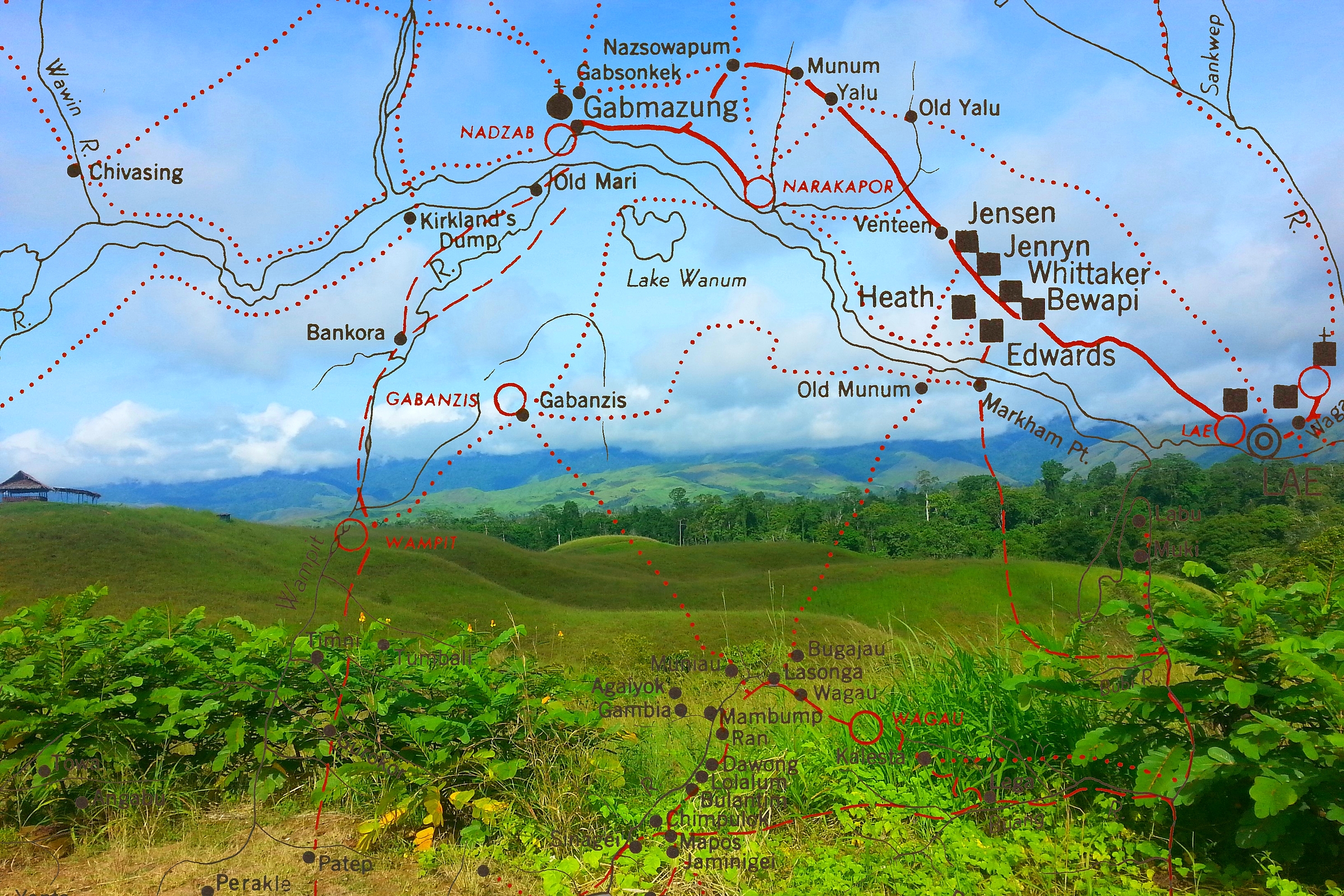
Willem Church is a lecturer at the University of Lucerne and an associate researcher with the BirthRites Research Group at the Max Planck Institute for Evolutionary Anthropology. His 2025 publication, Ink and Land: Documenting Factionalism around a Prospective Mine in Papua New Guinea, is the book-length version of his doctoral thesis, completed under the supervision of Professor Bettina Beer at the University of Lucerne as part of the SNSF-funded research project “International capital and local inequality: A longitudinal ethnography of the Wampar (Papua New Guinea) under the impact of two large projects (a copper-gold mine and a timber biomass energy plant).” As part of his dissertation, Church conducted a total of 15 months of ethnological field research in Morobe Province, south of the Markham River in Papua New Guinea (see previous article). In 2021, his dissertation was recognised with a research award from the Frobenius Institute for Cultural Anthropological Research. Church’s current research works at the intersection of cultural evolution and social anthropology, utilising a mix of qualitative research and computational modelling to explore the demographic and genetic outcomes of different cultural and kinship dynamics. He is currently developing computational models to examine the limitations and potential of using ancient DNA to infer different forms of prehistoric social organisation.


