"Human rights are rooted in ecclesiastical legal culture."
In his new book, Professor of Ecclesiastical Law Adrian Loretan explains how today’s idea of democracy partly arose from Church jurisprudence. Recognising these theological and legal-philosophical foundations offers a deeper understanding of modern secular freedom.
By Robert Bossart
Adrian Loretan, your new book, hot off the press, is entitled “The Democratic Constitutional State – A History of Ideas”. The topic is particularly relevant at a time when democracy and the rule of law are under severe pressure.
Adrian Loretan: In light of current world events, I am struck by how often international law is disregarded. Time and again, the law of the strongest prevails over the strength of the law – a pattern that has repeatedly led to war in the past. Yet international law itself already arose in the 16th century from canonical legal thought, together with the idea of a League of Nations.
This may surprise many people. When we think of democracy and human rights, we first think of the Enlightenment or the French Revolution. However, you argue that important foundations were already laid in the Middle Ages, particularly through the jurisprudence of the Church. What do you mean by that?
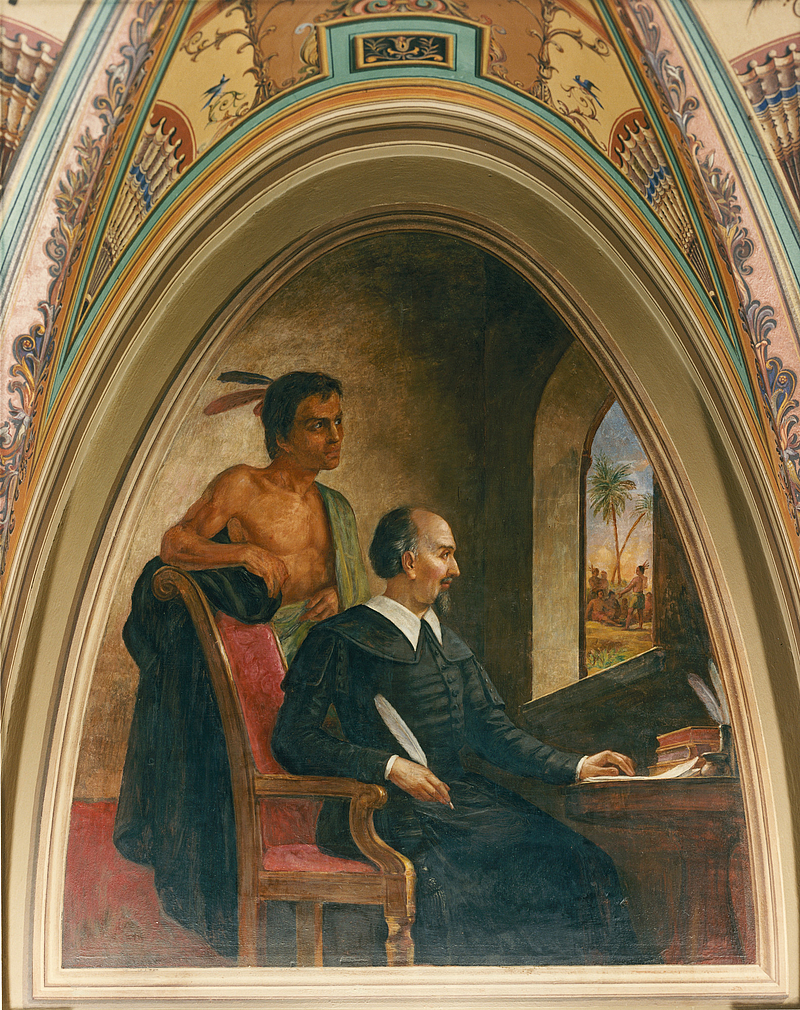
At the heart of the issue of human rights lies the question: why should we respect the rights of people with disabilities, the elderly, Jews, and others? From a Christian perspective, Christ is present in these groups and individuals. In the Bible, he says: “Whatever you did for one of the least of these brothers and sisters of mine, you did for me.” In the 16th century, the Spanish canon lawyer Bartolomé de Las Casas rephrased this in secular, worldly terms: every human being possesses human dignity, and with it the human rights that follow from it.
So it was actually the Western Church that developed a democratic legal culture. What exactly do you mean by that, and how did this shape political thinking in Europe?
In the American Declaration of Independence of 1776, the future president Thomas Jefferson wrote: “We hold these truths to be self-evident, that all men are created equal, that they are endowed by their Creator with certain unalienable Rights.” The ancient philosophers Plato and Aristotle did not speak of human rights. According to Brian Tierney (1922–2019), professor of humanistic studies, this human rights justification of the Declaration of Independence was only made possible through the natural law tradition of the Church’s jurisprudence. These human rights, in turn, became the secular foundation of our Western legal systems.
In your publication, you discuss in detail the principle from canon law that “What concerns everyone must be dealt with and decided by everyone”. Was this democratic understanding revolutionary?
Yes – it was entirely foreign to the feudal order of the Middle Ages. According to the philosopher and sociologist Jürgen Habermas, this canon law principle became a driving force in the modernisation of medieval society. Universities, guilds, cooperatives and corporations organised themselves in line with democratic ecclesiastical law. This democratic understanding of law was later taken up by medieval cities and, after 1648, by the public law of the modern state.
Many consider the Middle Ages to have been “dark” and backward. But you paint a different picture. What concrete contributions did the Church make to the development of freedom and the rule of law during this period?
After the French Revolution, people spoke of “enlightenment” and claimed that only “darkness” had prevailed before. Yet in the Middle Ages, the university emerged as a kind of “think tank”, founded on canonical legal principles, and Aristotle was rediscovered for Western Europe. State power was no longer explained solely through Augustine's doctrine of original sin, but was given a secular foundation in the idea of man as a political being. A key figure in this shift was Thomas Aquinas (1225–1274), who argued for an understanding of law rooted in reason. The Italian historian Paolo Prodi (1932–2016) called this reception of Aristotle “one of the greatest turning points in the history of Western political thought”. It paved the way for the doctrines of democratic participation and freedom.
You write that the idea of human rights was developed in 13th-century ecclesiastical jurisprudence. How did this development come about – and why is it so rarely mentioned?
The subjective rights of “natural rights”, or human rights, are an original contribution to legal philosophy made by medieval and modern ecclesiastical jurisprudence. Why is this not widely known? Quite simply because the colonial power Spain suppressed this human rights thinking. It was only after the death of the dictator Franco (1892–1975) that the works of Bartolomé de Las Casas, who had defended the rights of indigenous peoples in Latin America, were republished. This makes clear that as early as the 16th century, this canon lawyer was already arguing for human rights within international law. That body of international law was developed by his teacher, Francisco de Vitoria, in Salamanca – today one of the University of Lucerne's partner universities.
In your book, you also emphasise that the law can be an effective means of combating abuse of power – even within the Church itself. What is the current situation regarding the enforcement of such rights within the Church?
Five research volumes on the subject of abuse of power and sexualised violence have just been published in the series "ReligionsRecht im Dialog / Law and Religion”, which I edit. Researchers are working on solutions to tackle this problem. Those affected must be able to assert their rights in court, which requires the involvement of lawyers experienced not only in state courts but also in ecclesiastical ones. A separation of powers is essential, so that bishops too can be held accountable. The Church must return to its own democratic legal tradition – a tradition it reaffirmed in 1965 at the Second Vatican Council.
In the 20th century, the Church played a role in the creation of the Universal Declaration of Human Rights – partly through the efforts of Pope Pius XII. Why are many people unaware of this?
I wasn't initially aware of this either. My American research assistant drew my attention to a publication on the subject by Samuel Moyn, a Jewish legal historian from Yale. At the Wannsee Conference in 1942, it was decided to kill eleven million Jews in Europe. In a radio address that same year, Pope Pius XII declared that every human being possesses human dignity and the human rights that flow from it. This canon law argument later appeared in the UN Charter of 1945 and in the Universal Declaration of Human Rights of 1948. Incidentally, Catholic Ireland was the first country to enshrine human dignity and human rights in its constitution, in 1937.
You describe the rule of law and human rights as “fragile”. What is the most important lesson from the history of canon law for preserving these values in the future?
The rule of law and democracy are extremely fragile and cannot be taken for granted. For them to endure, we must be convinced of the need to stand up for them. My book and my work aim to foster understanding of the secular constitutional state as a peace project in dialogue with religious world views. In this context, it is important not to overlook the religious roots of modern freedom. Many Muslims reject the Western constitutional state because they see it as an irreligious project. Yet the Western constitutional state can only be fully grasped if it is justified on both secular and religious grounds. What is needed is an “overlapping consensus” of different world views on the constitution, as the American philosopher John Rawls (1921–2002) put it.
The subject matter of your book also forms the framework for your farewell lecture on 1 October – you will be retiring as professor emeritus at the end of January 2026 after 30 years of service. Your research, which began at the predecessor institution of the University of Lucerne, focused on justice, whether in relation to gender issues or sexual abuse in the Church. What are the most important “traces” you are leaving behind?
“Gender Equality and the Churches” was the title of my first conference proceedings. I have edited over 50 books. I don't know how successful any of them are. “The Democratic Constitutional State – A History of Ideas: On the Legal Culture of the West and the Western Church”, my latest volume, which is also available in open access, presents legal-historical and legal-philosophical arguments for democratic institutions and is therefore very close to my heart.
What are your plans for the future?
I am delighted that I will be able to sail in somewhat calmer waters from February onwards. That's why I plan to slow down a little, go hiking and cultivate friendships. Now, on 1 October, I will bid farewell at my lecture in the Jesuit Church of a university uniquely legitimised by direct democratic vote – a distinction that makes it a rare and welcome exception worldwide.
This article was originally published in the German-language cogito.


