Research dialogue on «Being»
«Being is said in many ways, in many languages, in many traditions»: A conference at the University of Lucerne brings together Jewish, Christian, and Muslim scholars
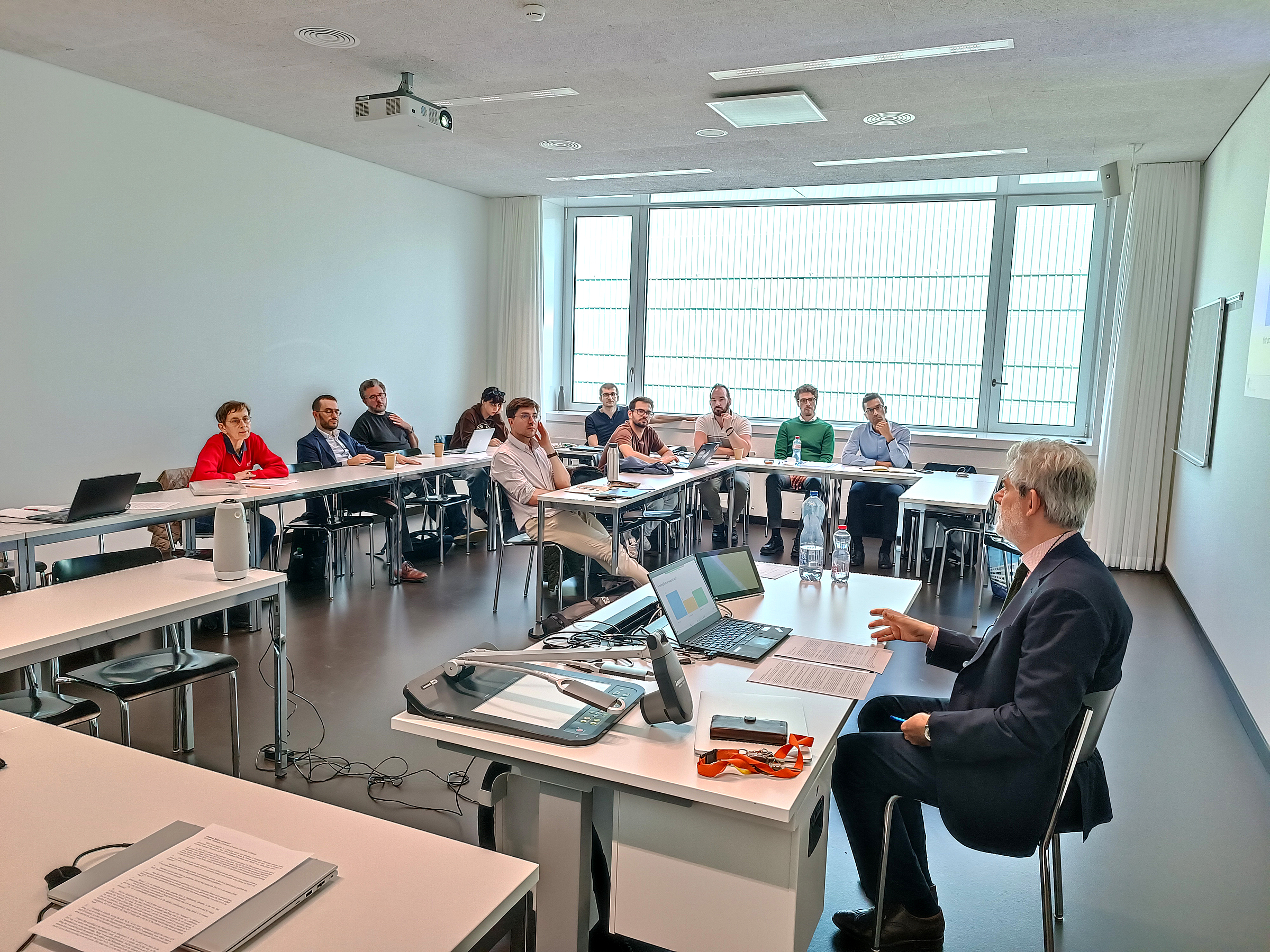
From New York to Tübingen, from Washington D.C. to Freiburg, from Paris to Tel Aviv, and all the way to Cologne and Munich—experts in Jewish, Christian, and Islamic philosophy and theology gathered at the University of Lucerne from 4 to 7 September for the international conference “Being is said in many ways, in many languages, in many traditions.” The event, funded by the University’s Research Commission, marked the conclusion of the project “Senses of Being” led by Professor Giovanni Ventimiglia and his team: Marta Borgo (Paris/Lucerne), Mostafa Najafi (Lucerne), Iacopo Costa (Paris/Lucerne), and Davide Falessi (Lucerne/Paris).
Among the international guests were Professor Kristell Trego (University of Freiburg), an expert in Latin and Arabic philosophy; Professor Silvia Donati (University of Cologne), a specialist in the Latin reception of Aristotle; Professor Gyula Klima (Fordham University, New York), a scholar of 13th–14th-century Latin philosophy and contemporary thought; Professor Yehuda Halper (Bar-Ilan University, Israel), an authority on the Jewish tradition; Francesco Zamboni (University of Tübingen) and Zachary Candy (a Canadian doctoral student working in Munich and Lucerne), both engaged in research on Arabic philosophy and theology; as well as Professors Gregory Doolan (Catholic University of America) and Fabrizio Amerini (University of Parma), both experts in the medieval Latin tradition.
The conference focused on the reception of Aristotle’s doctrine regarding the plurality of meanings of being—a subject which is central to his metaphysics. Since the Middle Ages, this theme has profoundly shaped the agendas of Jewish, Christian, and Muslim philosophers and theologians alike. In all three Abrahamic faiths, God is understood as pure act, identical with his very being. The contributors' talks emphasised how, over the centuries, Aristotelian metaphysics has served as a bridge, enabling religions and cultures to connect, enrich each other, and evolve together. For instance, Thomas Aquinas, one of the greatest philosophers and theologians of the Christian West, was initially trained by studying the commentaries on Aristotle written by the Muslim philosopher Averroes, as well as the Guide for the Perplexed by the Jewish thinker Moses Maimonides.
The conference fully reflected the mission of the Centre for Philosophy and Theology of Religions (TheiRs), directed by Professor Ventimiglia: to build bridges across religions, languages, cultures, and traditions, and to make philosophy a shared platform for dialogue.
Beyond the diversity of religious traditions represented, another hallmark of the conference was its focus on multilingualism and a broad view of the history of philosophy that extends beyond the West. True to this linguistic and cultural diversity, which has shaped philosophy historically for centuries, participants analysed texts not only in English or German, as is often the case at universities, but also in Ancient Greek, Latin, Arabic and Hebrew. This approach created space for intellectual traditions often marginalised in Western universities, such as Jewish and Islamic traditions. Indeed, the speakers highlighted authors from these traditions who are almost always absent from academic debate—dismissed as “minor” or simply overlooked. Thanks to the transcription of unpublished manuscripts by Professor Ventimiglia’s team, important Latin texts, previously inaccessible, were introduced to the international scholarly community.
The conference concluded by summarising the results of four years of research and discussing strategies for disseminating them, including pedagogical approaches. For the Centre for Philosophy and Theology of Religions (TheiRs), teaching and knowledge-sharing are integral to its mission. The outcomes so far have been very promising. For example, in the master’s programme “Philosophy, Theology and Religions”, Christian, Jewish, Muslim, and atheist students from around the world—Switzerland, the United States, Iran, Russia, Germany, Egypt, India, and Italy, to name some of the most represented countries—debate topics such as the nature of God, Aristotelian philosophy, and the current issues faced in philosophy of religion with academic rigour and mutual respect.
These are encouraging signs for the Faculty of Theology at the University of Lucerne, which has long established itself as a centre of research and teaching where interreligious dialogue is not just a theoretical academic subject but a daily practice—carried out seriously and peacefully, even over lunch in the university cafeteria.


