3 Years of the Faculty of Health Sciences and Medicine: A Conversation with the Founding Dean
On February 1, 2023, the Department of Health Sciences and Medicine was transformed into a faculty. Over the past three years, a great deal has happened in both teaching and research, and developments are still ongoing. In this interview, founding dean Stefan Boes reflects on the past three years as Faculty of Health Sciences and Medicine (GMF), shares his vision for the future, and discusses how the faculty lives its mission every day.
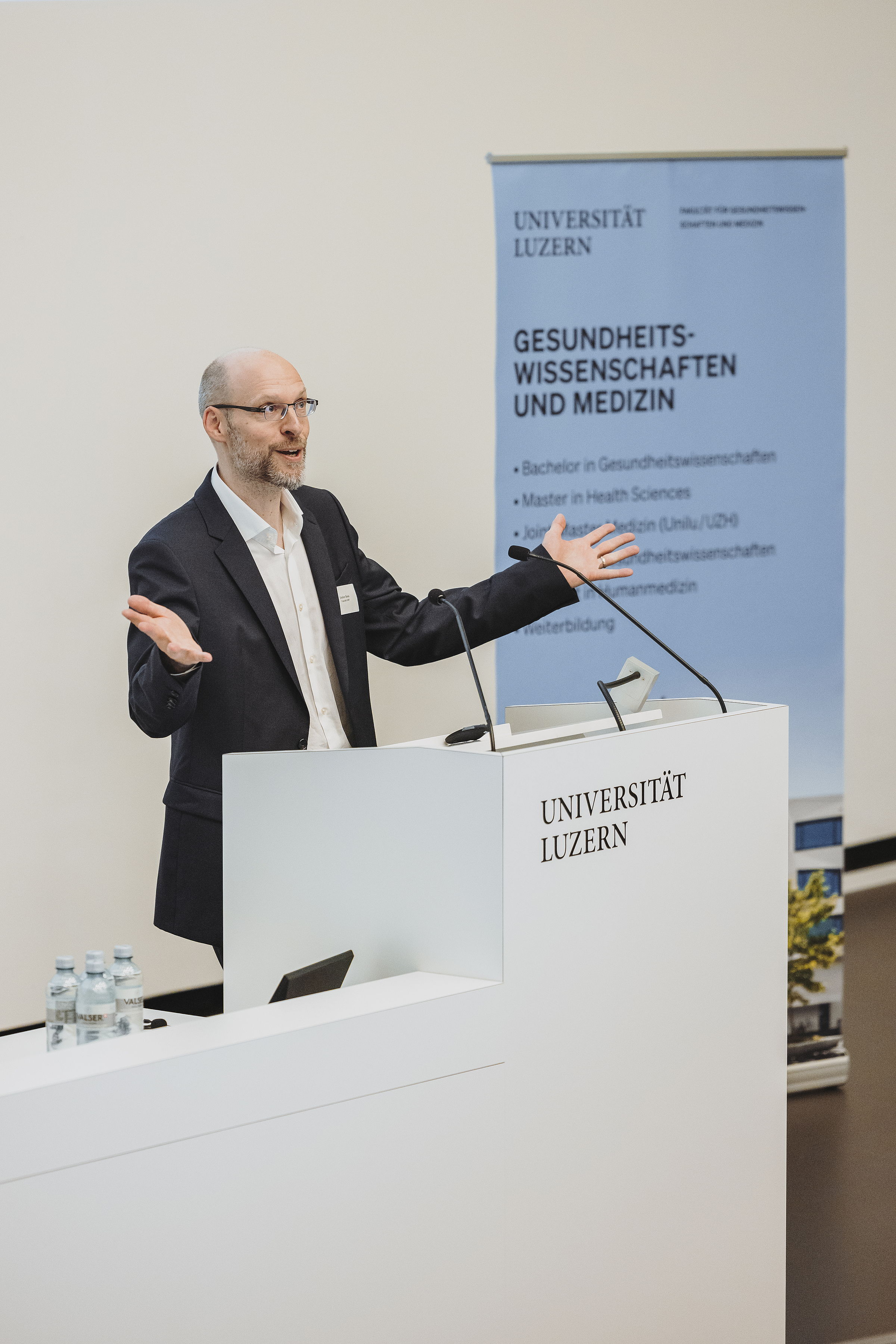
Three years of GMF – what is the first thing that comes to mind?
Stefan Boes: Above all, gratitude and pride. Gratitude for the people who bring this faculty to life: students, staff, lecturers, researchers, and our partner institutions. And pride in what we have been able to achieve as a young faculty in a very short period of time.
Looking back at the founding phase, what surprised you most, and what captures a typical day as a founding dean?
The biggest surprise was how quickly an idea can turn into a functioning day-to-day faculty operation when many smart minds pitch in at the same time. A very typical “founding dean’s day” meant discussing vision, strategy, and curriculum planning in the morning and then, in the afternoon, shaping the faculty’s profile in an appointment committee. It was very time-intensive, and I also learned a great deal about the university’s internal processes. What truly makes me happy, though, is that over the past six to seven years we have roughly tripled the number of professorships and newly enrolled students. This is a strong signal that we have not only grown but have also become better and more attractive.

Was there a moment when you thought, “Now we truly are a faculty”?
Yes, several. One very clear moment was when we were able to move into our offices at Alpenquai. Even though we are, of course, still closely connected to the main building, this gave our researchers and lecturers a shared space for exchange and creation.
Another moment was when we had to seriously consider how to organize our graduation ceremony logistically, because the number of graduates and their guests is slowly exceeding the capacity of Lecture Hall 1. Or when we were annoyed that the university’s IT system still listed us as GWM instead of GMF.
Then it was clear: we had arrived. Not because everything always runs smoothly, but because we find solutions, even when they involve improvisation. Overall, this mix of professionalism and pragmatism has carried our development in a very positive way. And yes, the debate about the appropriate use of ChatGPT by students is now probably just as much a part of everyday university life as the classic question, “Is this going to be on the exam?”.

How do you see the faculty’s positioning? What is your vision?
We defined our vision in our mission statement, deliberately simple and at the same time ambitious: to promote the health, functional ability, and well-being of individuals and communities. That is more than a medical objective. It is a societal mandate. Functional ability means participation in family life, in work, and in the community. This is exactly our approach: interdisciplinary and practice-oriented, and with a clear view toward the health care system of tomorrow.
And how do you translate this vision into the faculty’s daily work?
The translation of the vision happens through our mission. We aim to promote forward-looking research that crosses disciplinary boundaries and is visible internationally. Research-based, practice-oriented, and high-quality teaching, as well as the promotion of early-career researchers, are also key priorities of our mission. These elements go hand in hand with creating and strengthening a culture that enables critical thinking and open dialogue, including with policymakers and practitioners.
Strengthening research is one of the faculty’s central strategic goals. What does that look like in practice?
We want to further sharpen our research profile by being methodologically rigorous, thematically open, and socially relevant. This also includes attracting outstanding researchers. Over the next one to two years, we plan to strategically strengthen the faculty through new professorships in Learning Health Systems, Primary Care and Community Care, and Blockchain and Health. At the same time, we are pursuing two large-scale projects: one focused on the implementation of health system innovations and another on early childhood health. These initiatives will strengthen the faculty as a whole, and we naturally hope they will also lead to increased success in securing competitive third-party funding.
Another goal is the further development of the study programs. You have emphasized several times that you want to expand only selectively. How do these two ideas fit together?
Quality is our hallmark, and it should remain so. For our programs in health sciences, this means selectively adding new topics, methods, and fields of practice while continuing to leverage the strengths of our favorable student-to-faculty ratio. The same naturally applies to medicine. At the same time, the national context is very dynamic. Increasing student capacity in coordination with our partner institutions would be a demanding task, but also a key investment in regional health care security – one we would be happy to support.
A third focus is the promotion of young talent. What matters most to you here?
Supporting young researchers is not a “nice to have” for us. It is essential to the faculty’s future viability. We want to give young researchers space to grow through mentoring, exchange, structured qualification pathways, and genuine career prospects. In the coming year, we plan to further develop our doctoral program in health sciences. This is intended to strengthen academic training while also opening up new opportunities for our postdoctoral researchers.
What does this mean in terms of the faculty’s values?
We place great importance on diversity, interdisciplinarity, and internationalization. Their added value is evident every day. When health sciences and medicine think together, better questions and better answers emerge. We just saw this very clearly at our Mini Faculty Retreat a few weeks ago. Interdisciplinarity should become even more deeply embedded in our culture and our way of thinking. Internationalization broadens our perspectives through exchange programs and international partnerships. At the same time, the faculty cannot grow or function without appropriate support structures. We therefore need to plan carefully and provide the necessary resources to continue strengthening the faculty.
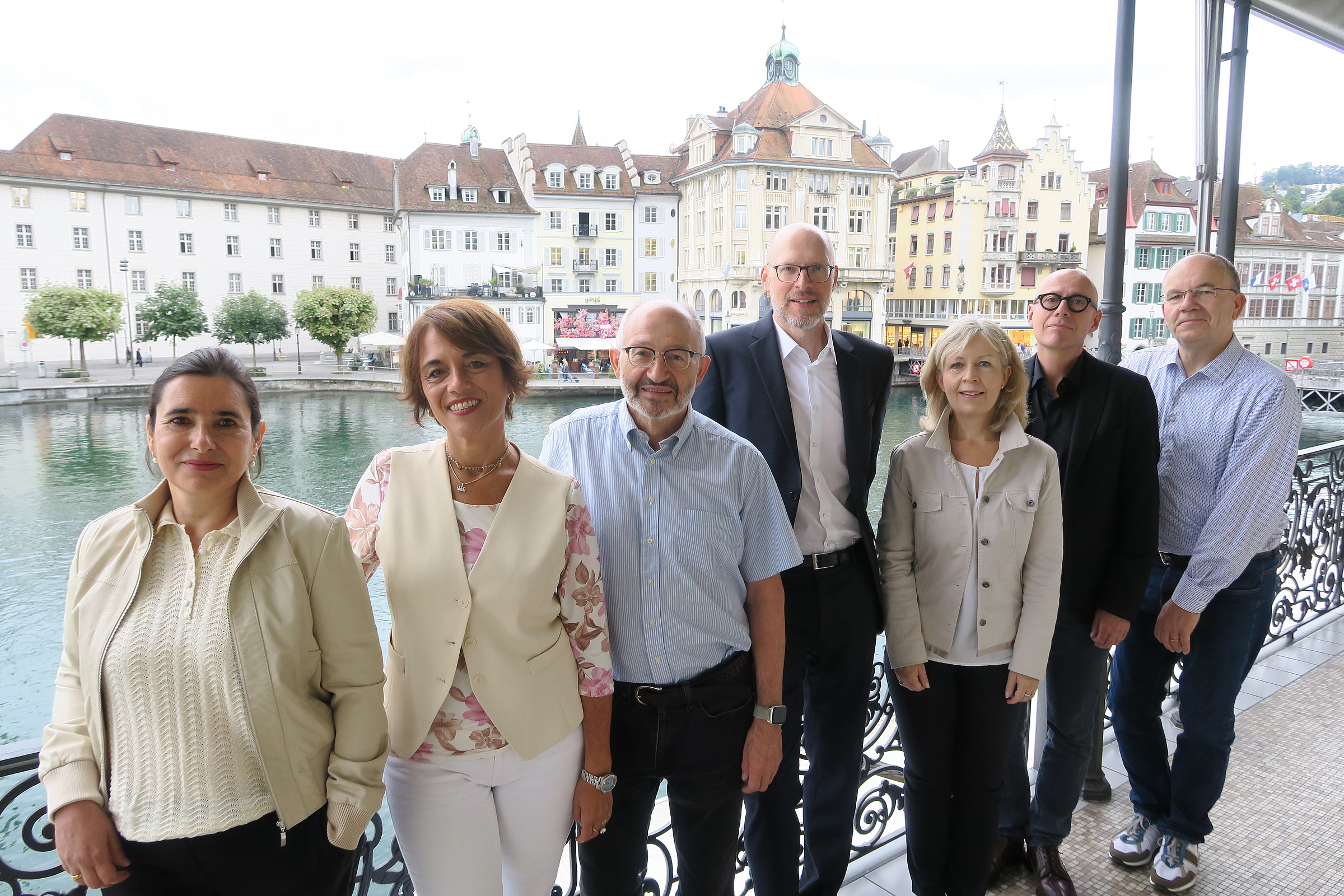
And what added value does the faculty create for Central Switzerland?
Being part of GMF means taking responsibility. We work within a strong network of health sector stakeholders. This closeness to practice is an opportunity and enables research and teaching with immediate relevance to society. At the same time, we want to further increase our visibility, not as an end in itself, but so that our insights reach those places where they can truly make a difference. In addition to strengthening our existing partnerships, it is very much our goal to expand the network across all of Central Switzerland. We see ourselves as a university and as a Faculty of Health Sciences and Medicine for the entire region.
Looking ahead, what’s your wish for the GMF?
I hope that we continue on our path with consistency, with excellent research, consistently high quality in teaching, growing clinical and societal impact, and with a faculty that stands together as a community. If we succeed in this, the “terrible twos” will, in retrospect, have been just a small step in a long and successful development for the University of Lucerne, for our partners, and above all for the health of the people whom our commitment ultimately serves.
Mission statement and strategic goals 2025–2028
News article regarding the founding of the faculty (Article in German, 27 June 2023)


