Completed projects
This project aimed to describe how the COVID-19 pandemic has changed our lives.
In spring 2020 (during the first wave of the COVID-19 pandemic), 1757 people from the Swiss population completed an online questionnaire. We assessed health, well-being (for example, anxiety, depressive symptoms but also positive changes), and quality of life using standardised questions. We also collected data on the economic and social situation of the participants. For example, we asked how their professional situation had changed or how parents cared for their children during this time.
In an earlier study in 2015-2016, we had already surveyed the Swiss general population on these topics. Hence, we can compare the situation during the first wave of the COVID-19 pandemic to the situation preceding the pandemic. With this study, we are able to show the impact the COVID-19 pandemic has had on the Swiss population. The results help describing the burden of the Swiss population and identifying support measures.
Funding: Research Commission of the University of Lucerne
Project leaders: Prof. Dr. Gisela Michel, Dr. Katharina Roser, Dr. Grit Sommer (University of Bern), Dr. Vera Mitter (Universities of Bern and Oslo)
Team: Dr. Daniela Dyntar; Dr. Julia Bänziger; Dr. Anica Ilic; Dr. Luzius Mader (University of Bern)
Duration: March 2020 – April 2021

A childhood cancer diagnosis is devastating for the whole family. Research has been done concerning the impact of childhood cancer on parents and siblings, but little is known about the impact of a childhood cancer diagnosis on grandparents. Grandparents play an essential role in caring for their grandchildren and are an important source of support. Studies in grandparents of children suffering from other diseases such as autism or other disabilities, have shown that grandparents are affected in many ways. The proposed study aims to fill the knowledge gap on grandparents with a grandchild suffering from childhood cancer.
The present study aims to determine: 1) how and to what extent are grandparents involved in the care of their grandchildren during and shortly after cancer treatment; 2) the economic costs of the care provided by grandparents; 3) the information needs of grandparents; and 4) the short- and long-term consequences of a childhood cancer diagnosis for grandparents.
We use mixed methods, combining different study designs and qualitative and quantitative approaches. These include: 1) a longitudinal study on the care and short-term consequences in grandparents of childhood cancer patients; 2) a qualitative study on the experiences of grandparents of childhood cancer patients under treatment; and 3) a cross-sectional study on long-term consequences in grandparents of childhood cancer survivors. Participants include grandparents of children diagnosed with cancer, their parents, the children diagnosed with cancer, and their siblings. The families were recruited in collaboration with the participating pediatric oncology clinics.
The current project is the first longitudinal study on grandparents of grandchildren with cancer in Europe and the first to include self-reported information from three generations (children, parents, and grandparents). Furthermore, the results will provide knowledge on informal care supplied by grandparents, estimate the costs, and describe the information needs and acute and long-term consequences in grandparents. Results will support the development of information material and support services tailored to the needs of grandparents with an ill grandchild.
Funding: Swiss National Science Foundation (Grant No: 10001C_182129/1)
Project Leaders: Prof. Dr. Gisela Michel; Prof. Dr. Katrin Scheinemann
Team: Dr. Peter Francis Raguindin; Dr. Anica Ilic; Dr. Katharina Roser; Cristina Priboi, MSc; Pauline Holmer, MSc; Nadja Mühlebach, MSc; (former collaborators: Dr. Daniela Dyntar; Salome Christen, MA)
Duration: April 2019 - September 2024
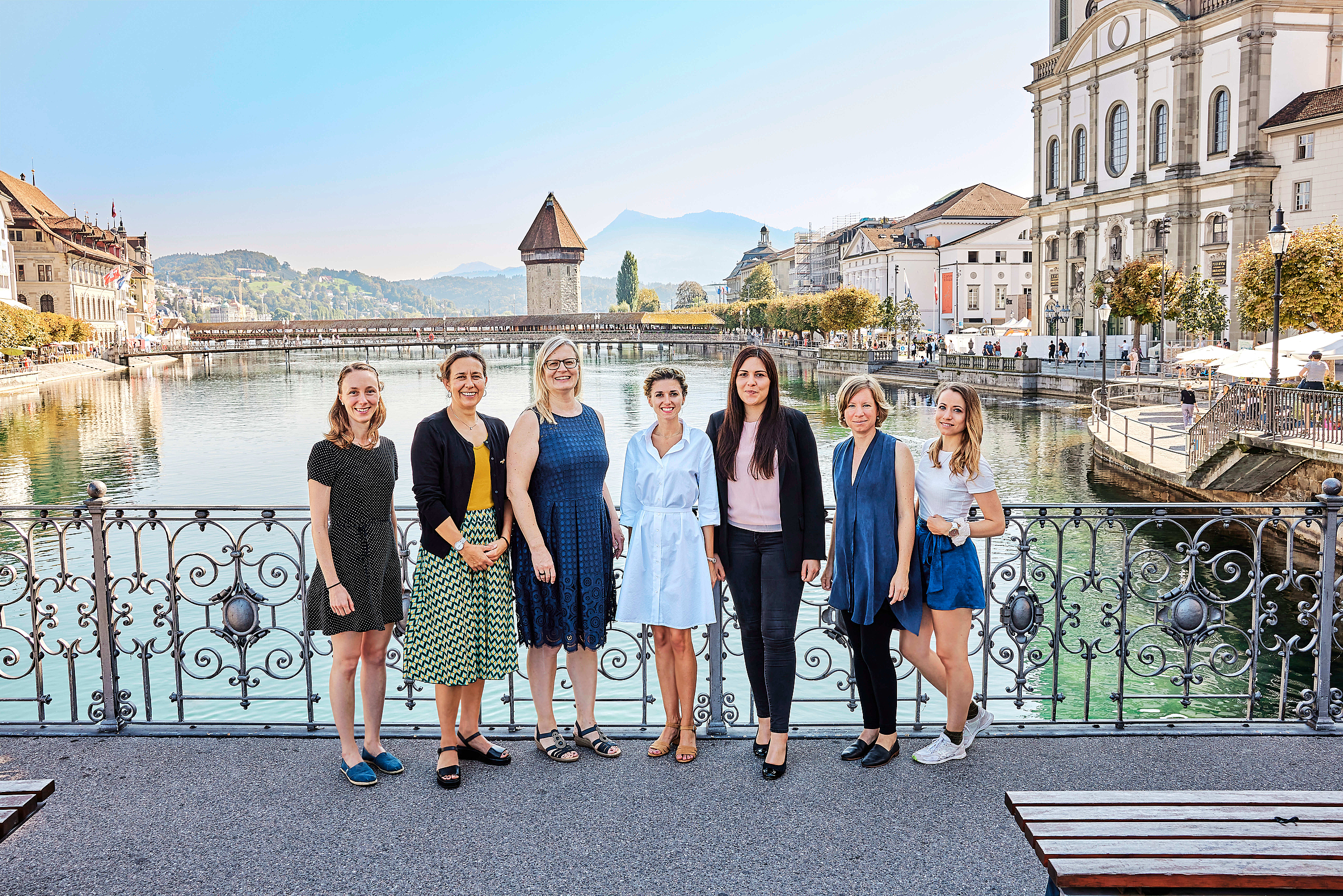
From left to right: Salome Christen, Gisela Michel, Daniela Dyntar, Cristina Priboi, Anica Ilic, Katharina Roser, Julia Baenziger
Copyright: Dyntar Photography. https://www.mein-fotograf-luzern.ch/
Childhood cancer is the second most common cause of death in children, but 5-year survival rates in Switzerland have reached 88%. However, a childhood cancer diagnosis is still a devastating event for the whole family. Research has been done concerning the impact of childhood cancer on the family system and on parents and siblings, but little is known about the impact of a childhood cancer diagnosis on grandparents. Grandparents play an important role in taking care of their grandchildren and are an important source for support. Studies in grandparents of a grandchild suffering from other diseases such as autism or disabilities have shown that grandparents are affected in many ways. The proposed study aims to fill the gap of knowledge on grandparents with a grandchild suffering from childhood cancer.
The present study aims to determine: 1) how and to what extent are grandparents involved in the care of their grandchildren during and shortly after cancer treatment; 2) the economic costs of the care provided by grandparents; 3) the information needs of grandparents on childhood cancer; 4) the short- and long-term consequences for grandparents of a cancer diagnosis in a grandchild.
We will apply mixed-methods combining different study designs and qualitative and quantitative approaches. These include 1) longitudinal study on the care and short-term consequences in grandparents of childhood cancer patients; 2) qualitative study on the experiences of grandparents of childhood cancer patients in treatment; and 3) cross-sectional study on long-term consequences in grandparents of childhood cancer survivors. Participants will be recruited in collaboration with the participating pediatric oncology clinics and will include grandparents of patients diagnosed with childhood cancer, parents of the same patients, the patients diagnosed with cancer and their siblings.
The current project will be the first longitudinal study on grandparents of grandchildren with cancer in Europe and the first to include self-reported information from three generations (grandchildren, parents and grandparents). Furthermore, the results will provide knowledge on informal care supplied by grandparents, estimate the costs, and describe acute and long-term consequences in grandparents. The gathered observations will enable to develop information material and support services especially tailored to the needs of grandparents who have an ill grandchild.
Funding: Swiss National Science Foundation (Grant No: 10001C_182129/1)
Project leader: Prof. Dr. Gisela Michel, Prof. Dr. Katrin Scheinemann
Team: Dr. Katharina Roser, Cristina Priboi, MSc
Duration: April 2019 – March 2022
Thanks to improvement in treatments, overall childhood cancer survival has improved to approximately 80% in most high-income countries over the past decades. However, survivors of childhood cancer are at considerable risk for a wide range of health conditions, including musculoskeletal late effects, cancer-related fatigue, and physical functioning deficits. Rehabilitation services like physiotherapy contribute to improving physical functioning and physical activity in patients with musculoskeletal problems or fatigue.
Overall, we aim to investigate the prevalence of musculoskeletal late effects, cancer-related fatigue, and physiotherapy utilization in survivors of childhood cancer, and to investigate physical functioning and physical activity in survivors with musculoskeletal late effects and in survivors with cancer-related fatigue.
This study will contribute to improving long-term follow-up care and rehabilitation services for survivors of childhood cancer with musculoskeletal late effects, cancer-related fatigue, or physical functioning deficits to ultimately minimize the burden of disease for survivors and improve their quality of life.
Funding: Vontobel-Stiftung, Faculty of Health Sciences and Medicine of the University of Lucerne, Krebsliga Zentralschweiz, Avenira Stiftung, and one anonymous foundation
Project Leader: Salome Christen MA
Team: Prof. Dr. Gisela Michel
Collaborators: Prof. Dr. med. Claudia Kuehni, Bern University (Principal Investigator of the Swiss Childhood Cancer Survivor Study; Head of the Childhood Cancer Registry)
Duration: September2021 – Dezember 2024
The EU-funded project PanCareFollowUp looks at how to best deliver survivorship care to survivors of childhood and adolescent cancer in Europe. Survival rates have improved over the last few decades but there is still a long way to go in long-term follow-up care for survivors of childhood cancer. This new focus in care and evaluation of care for survivors of childhood cancer is coordinated by Prof Leontien Kremer from the Princess Máxima Center for Pediatric Oncolology in Utrecht, The Netherlands. Fourteen partners from 10 European countries (Austria, Belgium, Czech Republic, Denmark, Ireland, Italy, The Netherlands, Sweden, Switzerland, United Kingdom) are participating.
PanCareFollowUp is aiming at delivering care according to recently developed guidelines using an innovative model for person centred care that empowers survivors and supports self-management. The objectives of PanCareFollowUp are to:
- Develop the PanCareFollowUp Care intervention, based on state-of-the-art knowledge, summarised in guidelines, about what regular surveillance individual survivors need and how it can be best delivered using person-centred care approaches
- Test the PanCareFollowUp Care intervention in four countries (Belgium, Czech Republic, Italy and Sweden) in partnership with 800 survivors, measuring effectiveness, value and cost-effectiveness
- Test the feasibility of using the European Survivorship Passport in delivering the PanCareFollowUp Care intervention in Italy and explore the development of an App
- Develop the PanCareFollowUp Lifestyle intervention, a person-centred eHealth lifestyle intervention tailored to meet the individual needs of survivors
- Test the PanCareFollowUp Lifestyle intervention in the Netherlands in partnership with 60 survivors, looking at effectiveness, acceptability and feasibility
- Develop materials to support replication of the PanCareFollowUp Care and Lifestyle interventions in new countries across Europe in the future
- Widely disseminate and communicate the available research to survivors and their families, researchers, healthcare professionals, healthcare decision-makers and policy-makers
The University of Lucerne is participating in Work Package 3, responsible for the development of the patient reported outcome measures (PROMs; Prof. Gisela Michel) and the health economic outcomes (Prof. Stefan Boes).
Funding: This project has received funding from the European Union’s Horizon 2020 research and innovation programme under grant agreement No 824982
Project team at University of Lucerne: Prof. Dr. Gisela Michel, Prof. Dr. Stefan Boes, Dr. Katharina Roser
Duration: January 2019 – December 2023
In the past decades, childhood cancer survival has improved reaching an overall 5-year survival of approximately 80%, resulting in a rapidly growing population of long-term survivors. However, more than 60% of survivors develop physical and psychological late effects due to cancer and its treatment. Several studies suggested that 20-30% of survivors report moderate to severe psychological distress, fatigue, or neurocognitive impairments. Therefore, it is essential for many survivors that they attend life-long follow-up care. Several guidelines for long-term follow-up of childhood, adolescent, and young adult cancer (CAYA) have been developed and published. However, the existing guidelines are often inconsistent, and some are not up to date anymore. This led to different recommendations and uncertainty among clinicians about which guidelines to use or implement in their country.

In collaboration with the International Guidelines Harmonization Group for Late Effects of Childhood Cancer (IGHG; www.ighg.org), we developed clinically relevant guidelines on psychological outcomes (psychosocial issues, mental health, and fatigue) to be used in follow-up care of CAYA cancer survivors.
Chaired by Prof. Gisela Michel and Prof. Jordan Gilleland Marchak (Emory University, Atlanta, USA), an international group of experts evaluated concordances and discordances among recommendations of existing guidelines and, in case of discordances, systematically reviewed all relevant literature on the stated topic. First, we formulated relevant clinical questions using the PICO model (Participants, Interventions, Control group, and Outcome). A systematic literature search was performed with the support of the Cochrane Childhood Cancer Group, which aimed to identify all available evidence. Two reviewers systematically reviewed all potential evidence. Finally, we will summarize the identified evidence and formulated specific recommendations.

Our study helped developing guidelines for the systematic surveillance of various psychological issues, mental health, and fatigue to address the needs of childhood cancer survivors and cancer survivors in general. The close international collaboration among researchers and clinicians helps ensure that guidelines can be implemented adequately and efficiently in practice.
Funding: Krebsliga Zentralschweiz
Project Leaders: Prof. Dr. Gisela Michel; Jordan Gilleland Marchak, PhD
Team in Luzern: Salome Christen, MA; Dr. Katharina Roser; Dr. Erika Harju; Dr. Anica Ilic
Duration: January 2016 - December 2021
Childhood cancer is considered the second most common cause of death in children over 1 year of age in high-income countries. Unfortunately, despite improvements in treatment in past decades, about 20% of children diagnosed with cancer die, meaning that almost 1 out of 5 families have to face such a devastating loss. The death of a child has been described as one of the most difficult events a family can face affecting each family member in a different and unique way.
Bereavement care, as one of the stages of paediatric palliative care, is committed to improve the quality of life and mitigate suffering of the bereaved family in a holistic manner. However, little is known about the bereavement care services that have been implemented in Switzerland and Europe. Additionally, not much is known about the needs of bereaved parents and how they fare in the long term. Finally, it is important to find out more about protective and/or risk factors of bereaved parents that might influence the long-term psycho-social outcomes in bereaved families.
The project’s main goal is to improve the bereavement support available to parents whose child has died from cancer. We have three specific aims:
Aim 1: Provide an overview on parents’ coping strategies after their child has died from cancer.
Method: Systematic review of the literature of published studies
Aim 2: Describe the availability and characteristics of palliative care services including bereavement resources offered to patients and family members in specialized paediatric oncology centres in Europe.
Method: A cross-sectional survey with healthcare professionals working at specialized paediatric oncology centres in Europe
Aim 3: Analyse the long-term psychological, and socio-demographic outcomes and support needs of bereaved parents in comparison to parents of long-term childhood cancer survivors, and parents from the general population in Switzerland.
Method: A mixed methods approach was used: a) in-depth interviews and b) a cross-sectional survey.
Bereavement Study - Updates Sept 2025
Funding: This project has received funding from the European Union’s Horizon 2020 research and innovation programme under the Marie Skłodowska-Curie grant agreement No 801076, through the SSPH+ Global PhD Fellowship Programme in Public Health Sciences (GlobalP3HS) of the Swiss School of Public Health” and Swiss Cancer Research grant No KFS-4995-02-2020 and Cancer League Central Switzerland
Project leader: Prof. Dr. Gisela Michel
Team: Dr. Eva de Clercq; Dr. Peter Francis Raguindin; Eddy Carolina Pedraza, MD; Anna Katharina Vokinger, MA
Collaborators: PD Dr. med. Eva Bergsträsser (University Children’s Hospital Zurich); Dr. med. Eva Maria Tinner (University Children’s Hospital Bern); Dr. Manya Hendriks
Duration: September 2019 – July 2024
When a child is diagnosed with cancer, parents are confronted with the potential fatality of the disease. They experience a highly stressful time, which may affect their psychological well-being, their relationship as a couple and with their children. Additionally, because of prolonged absence from work, they may experience an economic burden. However, for many parents distress is not over with the end of treatment and cure of the child. Parents may suffer from a variety of psychological problems such as depression, anxiety or post-traumatic stress symptoms. Uncertainty about the child’s health and worries about relapse or late effects may negatively affect parents individually or as a couple. So far, late outcomes of childhood cancer in parents have mostly been studied in small samples and within a short time frame after the end of treatment.
We aim to 1) describe psychological and socio-demographic outcomes, as well as needs in parents of long-term childhood cancer survivors and compare them with parents of the general population, 2) evaluate associations of these outcomes with the clinical characteristics of the child’s disease and the child’s own late outcomes and 3) provide Swiss norm-data for three established and frequently used instruments on quality of life, psychological distress and post-traumatic stress.
The Swiss Childhood Cancer Registry (SCCR) registers all children diagnosed with cancer in Switzerland. We include all parents whose children were diagnosed with cancer under age 16 years, who were Swiss residents at diagnosis, who survived for 5 years or more, and are currently alive and aged 20 years or older. Additionally, we selected a random sample of parents of the same age group. Parents of survivors are first contacted by paediatric oncologists of the original treating clinic. All parents receive a questionnaire package from the study centre. Clinical information on the cancer and treatment are available from the SCCR, and information about survivors’ health from the Swiss Childhood Cancer Survivor Study.
Several large cohort studies among childhood cancer survivors have improved our knowledge on their late outcomes and well-being. However, while most survivors get on with their life after cancer, many parents remain affected by their experience long after their child reached adulthood. The proposed study will be the first population-based study among parents of long-term survivors of childhood cancer and will shed light on their psychological well-being, social outcomes and the needs they have for their children and themselves.
Funding: Swiss National Science Foundation (Grant No: (Projekt Nr. 100019_153268), Kinderkrebshilfe Schweiz
Project leader: Prof. Dr. Gisela Michel
Team: Dr. Katharina Roser, Luzius Mader, Salome Christen, Julia Bänziger and Janine Vetsch.
Duration: August 2014 – December 2017
Treatment for cancer in children and young adults has greatly improved and most patients are being cured. The disease and the intensive treatment, however, make them susceptible to late effects. More than 50% of survivors of childhood cancer suffer from late effects and many die from these. In addition, a substantial number of survivors suffer from psychological problems such as depression, anxiety, or post-traumatic stress. To detect and treat late effects as early as possible it is important that survivors continue to visit follow-up care long after they have been cured from cancer. Various models of follow-up care have been described but so far none has been officially implemented in Switzerland. While follow-up care needs to be constantly updated according to the current status of research, it is also important that it is convenient for survivors to participate.
The aims of the project are: 1) to compare advantages and disadvantages of follow-up care models in Europe; 2) to determine what follow-up care is used in Switzerland; and 3) to determine the advantages and disadvantages of follow-up care models as perceived by survivors, oncologists and family practitioners, and to compare their views and opinions.
The research program consists of 3 projects. In Project 1 a questionnaire was sent to follow-up programs in Europe. In project 2, current use of follow-up care and psychological well-being has been determined in childhood cancer survivors. We used data from the Swiss Childhood Cancer Survivor Study for this project. For Project 3 a questionnaire was sent to young cancer survivors to assess their opinions on currently used and desired optimal follow-up care. The sample included childhood and young adult cancer survivors diagnosed between 1990 and 2007 aged under 25 years, who have survived for more than 5 years and who were aged 11 years and older at the time of study. In survivors aged 11-18 years at time of study parents completed the questionnaire. In addition oncologists/haematologists, and family practitioners received a questionnaire.
Although various models for the organisation of follow-up care have been suggested, none has been systematically implemented in Switzerland. The proposed project provides an overview of follow-up care models used in Europe and describes the preferences for follow-up care models in survivors, oncologists and family practitioners in Switzerland. The project provides the basis for the development of a standardised model of follow-up care for childhood cancer survivors in Switzerland in close collaboration with the Swiss Paediatric Oncology Group.
Funding: Swiss National Science Foundation (Ambizione Grant to Gisela Michel: No. PZ00P3_121682 / 1 and PZ00P3_141722 / 1)
Project leader: Gisela Michel
Duration: August 2009 – July 2014
Childhood cancer survivors are at high risk for psychosocial problems in adult life in terms of educational achievement or employment, the formation of intimate relationships, and psychological distress. However, survivors’ needs and preferences for psychosocial care outside the clinical context remain largely unknown.
Our project aims to 1) identify psychosocial problems that childhood cancer survivors encountered after being diagnosed and treated for their cancer, 2) evaluate how survivors coped with such problems and where they found help and support, and 3) assess survivors’ needs and preferences for future psychosocial care.
We will use a mixed methods approach, including quantitative questionnaires and qualitative interviews, to address the aims of our project. First, we will inform eligible survivors about the study and send them a link to an online questionnaire. The questionnaire will assess psychological distress, health-related quality of life, and survivors’ needs for psychosocial care. A subsample of survivors who completed the questionnaire will be invited for personal interviews addressing their lived experience and subjective needs and preferences for psychosocial care in more detail.
This project is a first step towards the development of psychosocial care services for survivors of childhood cancer and will inform health care providers and policy makers on survivors’ needs and preferences for psychosocial care along the cancer-survivorship trajectory.
Funding: Krebsforschung Schweiz (Nr. HSR-4080-11-2016)
Project Leader: Prof. Dr. Gisela Michel
Team: Dr. Manya Hendriks
Duration: November 2017 – Oktober 2019
With survival rates of 80% the population of childhood cancer survivors is rapidly growing. However, more than 60% of survivors report late effects, and in Switzerland around 25% of adult survivors report psychological distress at a clinical level. For these reasons, most childhood cancer survivors are advised to attend life-long follow-up aiming at screening for late complications. While screening for medical problems has been well-established, systematic psychological screening is not yet available. Several tools have been developed to be used with adult cancer patients on treatment, but their utility for the expanding population of cancer survivors has not been shown.
The present study aims to 1) test a screening tool for psychological distress in adolescent and adult childhood cancer survivors, 2) understand the emotional status of survivors and their parents before and after a follow-up visit, and 3) investigate the acceptability, arduousness, simplicity and perceived necessity of a screening instrument and the attitudes towards mental healthcare.
The sample will include childhood cancer survivors attending a follow up appointment in the paediatric oncology clinic of the University Children’s Hospital in Basel (UKBB) within a 1.5 year period (expected N=90) and their parents. Eligibility criteria for the present study are: age ≥15 years at the time of study, diagnosis of childhood cancer at age ≤18 years, off treatment ≥1 year. Survivors and their parents will receive an information letter and, one week before their follow-up appointment, a questionnaire including the screening tool (Emotion Thermometer) and questions on its acceptability. Additionally, the questionnaire will assess information on psychological distress (including SCL-90-R for validation of the screening tool, Post-Traumatic Stress Disorder Checklist – civilian version (PCL-C)), and socio-demographic information. After the appointment survivors will receive a second shorter questionnaire assessing psychological distress. Clinic staff’s opinion about the screening tool will be assessed in an online questionnaire.
The present study is the first step toward the implementation of systematic psychological screening during follow-up appointments. We will test a potential screening tool, and at the same time assess how survivors and clinic staff perceive psychological screening. Assessing psychological distress before and after the follow-up appointment will help evaluating the influence of the appointment itself on distress experienced around the appointment and additionally, how parents might influence distress. Close collaboration with clinicians in the Swiss Paediatric Oncology Group (SPOG) will allow implementing systematic screening for psychological distress in the daily follow-up routine in all nine paediatric oncology centres in Switzerland. Ultimately, screening will help patients and survivors to detect psychological distress early and provide timely professional counselling to those in need.
Funding: Cancer Research Switzerland (Projekt Nr. KSF-3955-08-2016)
Project Leader: Prof. Dr. Gisela Michel, Prof. Dr. Katrin Scheinemann (Universitätskinderklinik beider Basel)
Team: Erika Harju
Duration: Mai 2017 – April 2020

Cancer in adolescents and young adults (AYAs, 15-39 years of age) is different from cancer in children or in older adults. Due to the age at diagnosis of this group, important developmental tasks such as employment and education can be affected. However, research in AYAs with cancer is still limited. Therefore, there is a demand for investigating cancer epidemiology of AYA cancer and establishing well-designed studies to address psychosocial health of AYA cancer survivors.
The project consists of two studies and aims to:
- provide a detailed description of the epidemiology of AYA cancer in Switzerland (Epidemiology Study);
- assess psychosocial health, psychosocial problems and needs in AYA cancer survivors in Switzerland. (Psychosocial Health Study)
Study (i) is a retrospective, registry-based epidemiological study. AYAs diagnosed with cancer at the age of 15-39 years in Switzerland and registered in one of the cantonal cancer registries will be included in the analysis. Epidemiological measures including incidence rates for different cancer types and age groups and corresponding mortality and survival rates will be calculated for Switzerland.
Study (ii) consists of a cross-sectional online questionnaire survey in AYA cancer survivors in collaboration with cantonal cancer registries in Switzerland. We will include individuals having been diagnosed with cancer at the age of 15 to 39 years and having survived cancer for at least 2 years. The questionnaire will address their psychosocial situation (e.g. educational achievements, employment situation, partnership, health-related quality of life, and psychological distress), their psychosocial problems and needs at diagnosis and at time of study. We will describe psychosocial health in AYA cancer survivors in Switzerland in detail and compare it to available samples of the general population.
The project will give for the first time a detailed overview of the epidemiology of AYA cancer in Switzerland from a public health perspective. In addition, it will provide insights into psychosocial problems AYA cancer survivors might encounter during the cancer trajectory. The project will help to develop new and adapt existing support services for AYA cancer patients and survivors and consequently help to improve health and well-being of AYA cancer survivors.
Funding: Palatin-Stiftung, Zentralschweizer Krebsliga, Avenira Stiftung, and two anonymous foundations
Project leader: Dr. Katharina Roser
Team: Dr. Daniela Dyntar, Céline Bolliger, Michaela Kaufmann and Sebastian Thackwell
Duration: January 2020 – June 2024


