
Master in Health Sciences
Key information
| Awarded title | Master of Science in Health Sciences |
| Program duration | 2 years full-time / individual part-time solutions possible |
| Credits | 120 ECTS credits (based on the European Credit Transfer System (ECTS), with an estimated workload of 25-30 hours per credit) 90 ECTS-points for graduates of the BSc in Gesundheitswissenschaften |
| Program start | Fall semester (September); entry in the spring is possible for the 90 ECTS program |
| Language | English (no language certificate necessary, but level of C1 recommended) |
| Application deadline | 30 April via Uniportal (late applications possible, see here) |
Program structure
The two-year Master’s program with 120 credits includes core courses in the principles of health sciences, advanced research methods, and academic and professional skills. Students choose one of the following majors to get more in-depth knowledge depending on their professional interests and career direction:
- Health Communication
- Health and Social Behavior
- Health Economics and Policy
- Health Services Research
- Health Data Science
During the mandatory research internship, students apply the knowledge gained in the program and may choose to base their Master’s thesis on this experience.
Example Curriculum

Studying part-time
It is possible to attend the MSc in Health Sciences part-time. We do not offer a fixed part-time model, however, students can create their own individual part-time study plan.
When choosing less than the average of 30 ECTS-points per semester, students are considered to be studying part-time. There is no required minimum amount of ECTS-points per semester, and no maximum amount of number of semesters, during which the program has to be finished.
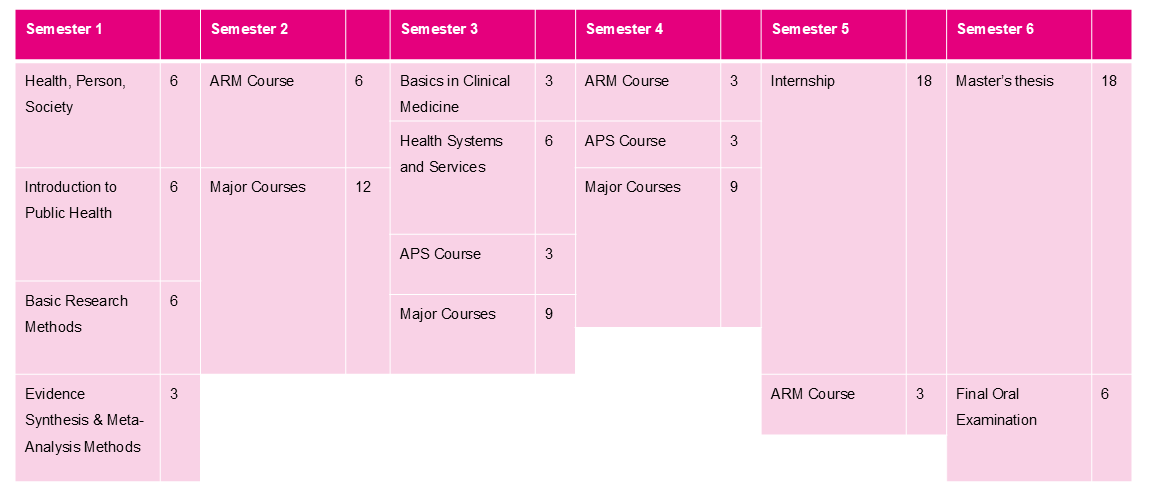
One option could be, to prolong the program to three years with six semesters. The curriculum could look like this:
Example Curriculum (part-time 1, 6 semesters)
Majors
Students choose and graduate within one Major. Through core and elective courses, students can create their own individual profile.
Communication is central to providing and promoting health care. Health communication involves studying and applying strategies to inform and influence individual and community decisions that improve health. The Major in Health Communication offers a scientific understanding of how health information is created, shared, and impacts individuals, communities, institutions, and public policy. It examines communication at three levels—individual (interpersonal and technology-enhanced), public (social marketing, health campaigns, and education), and institutional (knowledge translation from research to policy and practice).
Students explore topics such as health communication theories, persuasion, ethics, medical humanities, consumer health informatics, social marketing, and participatory design. The program prepares graduates for careers as managers in state and federal health agencies, managers in knowledge translations for healthcare institutions, public health leaders as well as educators and communication analysts for health promotion, advertising and marketing.
Psychological aspects and the social environment are key factors influencing health and health behavior. Attitudes, expectations, experiences, emotions, and stress shape how individuals act and perceive their health, while social and material conditions further affect behavior and well-being. Gaining an in-depth understanding of health behaviors and experiences is essential for developing effective interventions that enhance individual and public health.
The Major in Health and Social Behavior offers a solid theoretical and methodological foundation in the psychological, social, and cultural determinants of health. Through lectures, seminars, and workshops, students study topics such as health behavior theories, public health strategies, stress and coping, positive psychology, and health inequalities. Graduates are well prepared for careers in research, public health, and health organizations.
Expenditures for health care constitute are large and growing share of total public and private expenditures, which has led to concern amongst policymakers in many countries. On the other hand, the health sector produces a valuable output, health and health care, and hence it contributes to the general well-being of the population.
The Major in Health Economics and Policy examines the health system from both economic and political science perspectives. Its main goal is to understand how scarce resources are allocated in the health care market by combining positive and normative approaches. Students explore how health is valued economically, the dynamics of demand and supply in health care, and how the unique nature of health as a good shapes the behavior of key market actors. The program also emphasizes the role of policymakers in regulating the health sector and promoting population health, while developing students’ abilities to design, implement, and evaluate public health policies.
The curriculum includes topics such as health policy and governance, health economics and economic evaluation, decision-modeling and cost-effectiveness analysis, evaluation of public health policies, health systems research, global health policy and economics, applied health econometrics, and health care management. This Major prepares students for leadership roles in the public health sector, industry, and health-related organizations, as well as for academic careers.
The Major in Health Services Research focuses on the study of organizations, finance, manpower, technology, and prevention in health care delivery, and their effects on utilization, cost, and quality of care. It bridges clinical research and real-world medical practice to explain the “last mile” to the patient, aiming to improve the quality and efficiency of medical care at the population level.
This Major introduces key research domains of the health system and provides methodological tools to examine access, utilization, quality, and cost of care, with an emphasis on evaluating the effectiveness of health services. Topics include health system analysis, performance assessment, data sources for health services research, efficiency and effectiveness studies, and health care regulations. The program equips students with practical skills relevant for health policy decision-makers, private sector stakeholders, and academic researchers committed to advancing health care services.
Health data become available in ever larger quantities, level of detail, and they can and need to be accessed from a variety of sources. The Major in Health Data Science provides you with the necessary skills and knowledge to manage large and diverse datasets, to apply statistical and machine learning approaches to study and learn from the data, and to draw meaningful conclusions to inform health care practice and policy.
The Major in Health Data Science integrates methods from statistics, computer science, and software engineering within the health sciences, providing a critical understanding of key issues such as data security, ethics, and information governance.
Topics include machine learning for causal inference, computational epidemiology, analysis of routinely collected health care data, statistical programming, and health data challenges. This Major prepares students for careers as health data scientists in academic research, the public sector, or industry.
Research internship
The research internship is a mandatory module of the study program. Students gain first-hand experience applying their knowledge and skills in health sciences research and practice. Internships can be completed within our own research groups at the Faculty of Health Sciences and Medicine or with our partner institutions, including:
- Swiss Paraplegic Research
- Swiss Paraplegic Center
- Lucerne Cantonal Hospital
- Interface Politikstudien Forschung Beratung
External placements are also possible. Internships are organised independently by students, although the Faculty of Health Sciences and Medicine maintains an internship platform with regular internship offers.
Career prospects
The Master in Health Sciences provides ideal preparation for students aspiring to careers in the health sector within a dynamic and interdisciplinary environment, or who aim to pursue research in the broad field of health sciences.
Our program is dedicated to equipping students with the knowledge and skills needed to advance their careers in health-related fields, including positions in:
- Health administration and public health
- Research and academia
- Health education and health promotion
- Management in state and federal health agencies
- Other health-related industries
Admission
With its interdisciplinary perspective, the Master in Health Sciences attracts candidates from a wide range of educational backgrounds, including social sciences, economics, medicine, psychology, and other health-related disciplines. Students benefit from interaction within a diverse cohort of academic peers.
Admission requires a Bachelor’s degree (or an equivalent higher education degree) from a university recognized by the University of Lucerne. Please refer to the Admission Guidelines for detailed information and possible exceptions.
Application Deadline
The Master in Health Sciences begins each fall term. The application period for the fall intake runs from mid-February until April 30.
Late Applications
Late applications are accepted until August 31 with an additional fee of CHF 150. This option is only available to applicants who do not require a visa (citizens of CH, EU, EFTA, Japan, and New Zealand).
Fees
Thanks to Switzerland’s national commitment to education and generous funding from federal and cantonal governments, tuition fees at Swiss universities are relatively low. Please click here for detailed information on fees at the University of Lucerne.
Study regulations
For detailed information refer to our study and examination regulations of the Master of Science in Health Sciences.
Contact
Luisa Koller
Program Manager MSc Health Sciences
Dean's Office Health Sciences
T +41 41 229 59 59
Student counselling: University Lucerne, Room 3.A12
masterhealth@unilu.ch
Insights and important links


